Tag Archives: Energy Efficient Commercial Buildings

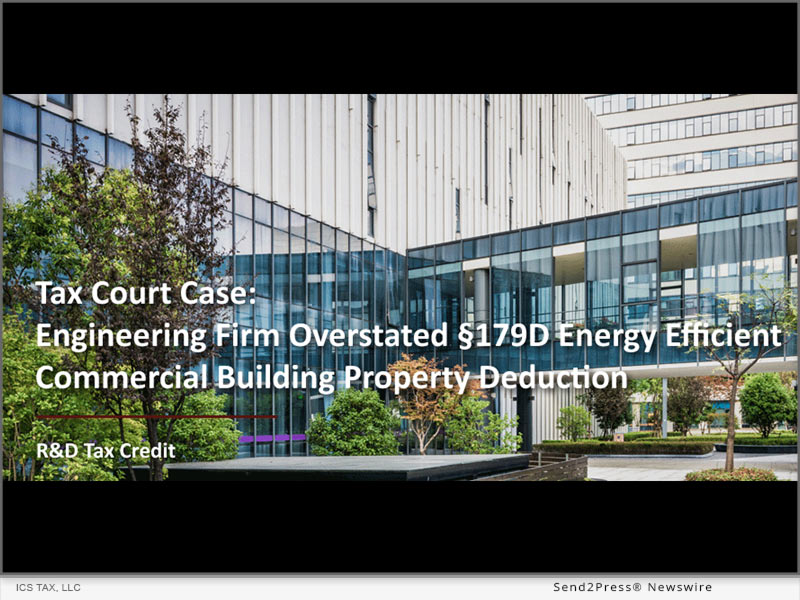
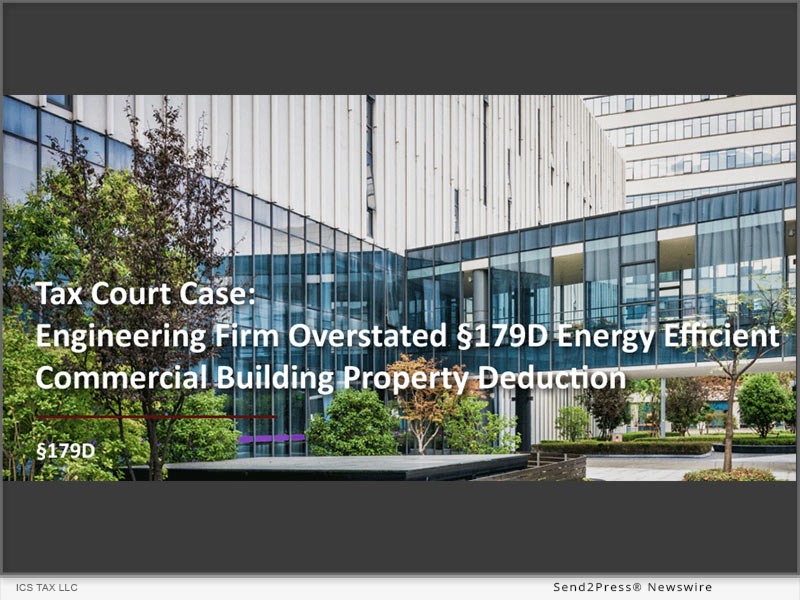
Tax Court Case: Engineering Firm Overstated §179D Energy Efficient Commercial Building Property Deduction

COLUMBUS, Ohio /ScoopCloud/ -- In a recent case, Michael Johnson, et ux. v. Commissioner, the tax court denied the majority of a taxpayer's Energy Efficient Commercial Building Deduction under IRC §179D since it claimed a §179D Deduction exceeding the cost of the Energy Efficient Commercial Building Property (EECBP), says ICS Tax, LLC.

Background

The §179D Deduction is a federal tax incentive designed to promote taxpayers to construct energy efficient buildings as well as encourage building owners to make improvements to existing structures that reduce energy and power costs. At the time of the case, the §179D Deduction provided a maximum deduction of up to $1.80 per square foot of the building's floor area and applies to interior lighting systems, heating, cooling, ventilation, hot water systems or building envelope. A special rule under §179D provides that architects, engineers, contractors, environmental consultants or energy services providers may also be eligible for the incentive on public projects. However, the amount of the §179D Deduction is limited to cost of the EECBP.

For an updated summary of the heavily revised §179D rules, go to https://ICS-Tax.com/179D.

The Case

In this case, the taxpayer was an engineering firm in the business of installing heating, ventilation, and air conditioning (HVAC) systems. The taxpayer installed HVAC systems in a U.S. Dept. of Veterans Affairs (VA) hospital. This engineering firm had the §179D Deduction allocated to them such that they claimed a deduction of $1,073,237 for the 2013 taxable year, which was equal to the product of $1.80 and 596,243, the hospital's square footage. However, the cost of the EECBP was only $304,640. Hence, the tax court concluded that the §179D deduction was limited to the $304,640 cost of the EECBP.

Many professional service providers lack the expertise to properly analyze the complex tax rules and engineering requirements for the §179D Deduction. For a tax incentive requiring both a thorough knowledge of the tax code and engineering principles, it is essential to hire a fully qualified and experienced team that includes CPAs, attorneys, and professional engineers. It is also essential to thoroughly vet your §179D service provider, and at a minimum, perform an Internet search that can yield critical information.

Author: Alexander Bagne, JD, CPA, MBA, CCSP

ABOUT ICS TAX:

ICS Tax, LLC (ICS) is a consulting firm providing innovative tax planning strategies. ICS collaborates with taxpayers and their tax professionals to identify credits and incentives that reduce tax liabilities and increase profitability. ICS provides nationwide service through its offices throughout the country. Learn more: https://ics-tax.com/.
News from ICS Tax LLC

In a recent case, Michael Johnson, et ux. v. Commissioner, the tax court denied the majority of a taxpayer's Energy Efficient Commercial Building Deduction under IRC §179D since it claimed a §179D Deduction exceeding the cost of the Energy Efficient Commercial Building Property (EECBP), says ICS Tax, LLC.

Related link: https://ics-tax.com/

This version of news story was published on ScoopCloud™ (ScoopCloud.com) - part of and © the Neotrope® News Network - all rights reserved.
IRS Releases Updated Practice Unit for Auditing the 179D Energy Efficient Commercial Buildings Deduction

EGAN, Minn. /ScoopCloud/ -- The IRS Large Business and International (LB&I) Division released an updated Practice Unit for its agents to audit the 179D Energy Efficient Commercial Buildings Deduction (179D Deduction), ICS Tax, LLC announced today. It confirms that taxpayers can use the ASHRAE Standard 90.1-2007 rather than newer, more strict standards but also could be an indication that the IRS will have added scrutiny on 179D projects.

179D DEDUCTION BACKGROUND

The 179D Deduction was enacted to encourage taxpayers to make buildings more energy efficient. Installation of energy-efficient commercial building property (EECBP) occurs when constructing a new, or improving an existing, commercial or government-owned building.

179D allows a taxpayer who owns or leases a commercial building to deduct the cost or a portion of the cost to install EECBP. Additionally, if the EECBP is installed in a government-owned building, the deduction can be allocated to the person(s) primarily responsible for designing the EECBP ("the Designer" or "the Designers").

EECBP must be part of at least one of three systems:

1 -- Interior lighting systems;

2 -- Heating, cooling, ventilation, and hot-water systems; or

3 -- The building's envelope.

To claim the 179D Deduction, a taxpayer generally hires a third-party Professional Engineer to perform energy modeling using IRS-approved software to confirm that the building meets the 179D requirements. The engineer then prepares a Certificate of Compliance to support the 179D Deduction.

THE ASHRAE STANDARD

The Taxpayer Certainty and Disaster Relief Act of 2020 updated the energy efficiency standard for the 179D Deduction by providing that for EECBP placed in service after December 31, 2020. EECBP means property that is within the scope of "Reference Standard 90.1." Amended 179D(c)(2) provides that "Reference Standard 90.1" means "the most recent Standard 90.1 published by [ASHRAE] which has been affirmed by the Secretary [of the Treasury], after consultation with the Secretary of Energy, for purposes of this section not later than the date that is 2 years before the date that construction of such property begins."

The LB&I revised Practice Unit states "The Secretary of the Treasury has not yet affirmed a new version of Reference Standard 90.1 for use with the IRC 179D deduction.... The ASHRAE Standard 90.1-2007 is the most current affirmed version as of the publication date of this Practice Unit." This means that taxpayers looking to benefit from the 179D Deduction can still qualify under the older ASHRAE standard.

INCREASED 179D SCRUTINY

The IRS recently announced it is looking to hire more than 4,000 representatives. A notable division within the IRS is the Criminal Investigation division. It is the investigative and law enforcement arm of the IRS with expertise in tax fraud, investment fraud, corruption, and much more. Earlier this year, a national tax consulting firm heavily involved with the 179D Deduction was raided by the IRS Criminal Investigation division. While the reason for the raid is not yet publicly known, the raid, the revised Practice Unit and the additional hiring could indicate that the IRS will have higher scrutiny on the 179D Deduction.

About ICS Tax, LLC:

ICS Tax, LLC has the expertise to properly obtain 179D Deductions. We have Professional Engineers licensed in all states to perform energy modeling, building inspections, and preparing certificates of compliance. For designers of public buildings, we also have government relations experts to complete and obtain allocations from government agencies.

For more information, please visit us at https://ics-tax.com/.

RELATED LINKS:

https://www.irs.gov/pub/irs-utl/irc-179d-energy-efficient.pdf

https://ics-tax.com/services/179d/

https://www.energy.gov/eere/buildings/qualified-software-calculating-commercial-building-tax-deductions

News from ICS Tax LLC

The IRS Large Business and International (LB&I) Division released an updated Practice Unit for its agents to audit the 179D Energy Efficient Commercial Buildings Deduction (179D Deduction), ICS Tax, LLC announced today. It confirms that taxpayers can use the ASHRAE Standard 90.1-2007 rather than newer, more strict standards but also could be an indication that the IRS will have added scrutiny on 179D projects.

Related link: https://ics-tax.com/

This version of news story was published on ScoopCloud™ (ScoopCloud.com) - part of and © the Neotrope® News Network - all rights reserved.