Author Archives: Save Long Beach Island (Save LBI)

New Jersey’s Save Long Beach Island Sues NOAA for Failure to Protect Migration Corridor of Critically Endangered North Atlantic Right Whale

Lawsuit seeks to compel NOAA to act on a year-old petition to designate the whale's migration path a 'critical habitat' to ensure its survival

LONG BEACH ISLAND, N.J., May 7, 2026 (SEND2PRESS NEWSWIRE) — Save Long Beach Island (Save LBI), a nonprofit, non-partisan organization dedicated to protecting our oceans from needless industrialization, along with other concerned parties, filed suit against the National Oceanic and Atmospheric Administration (NOAA) to compel the agency to act on a 2025 petition intended to protect the critically endangered North Atlantic right whale (NARW).
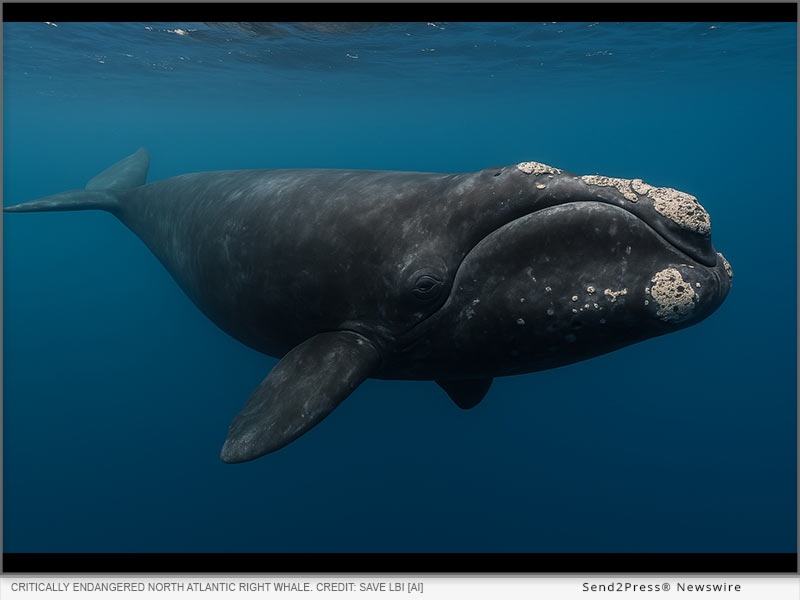
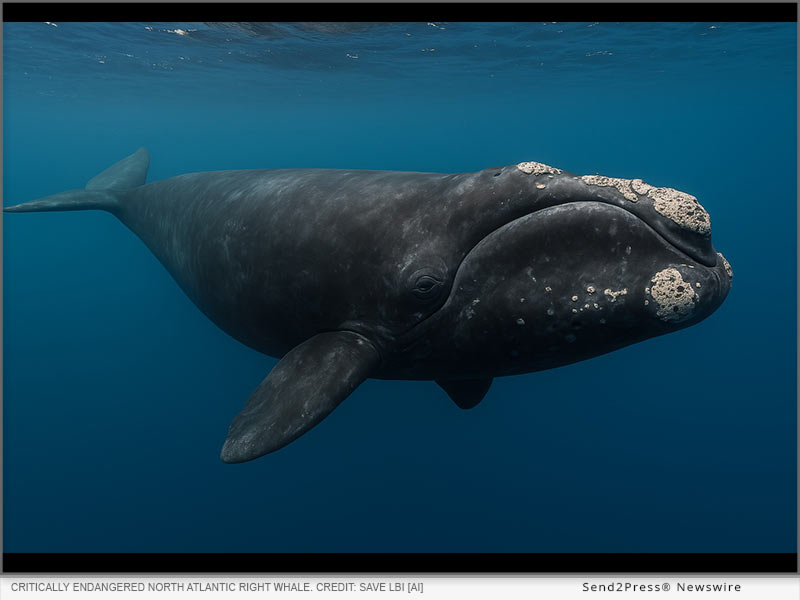
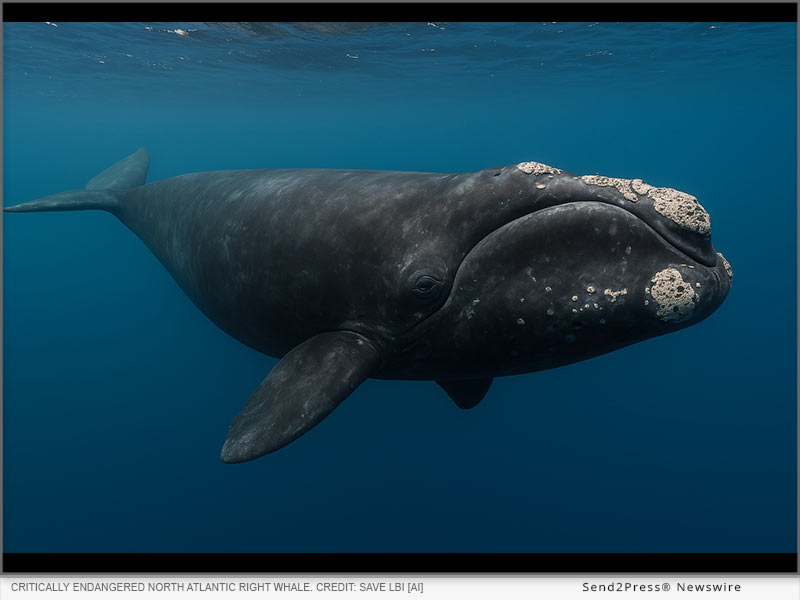
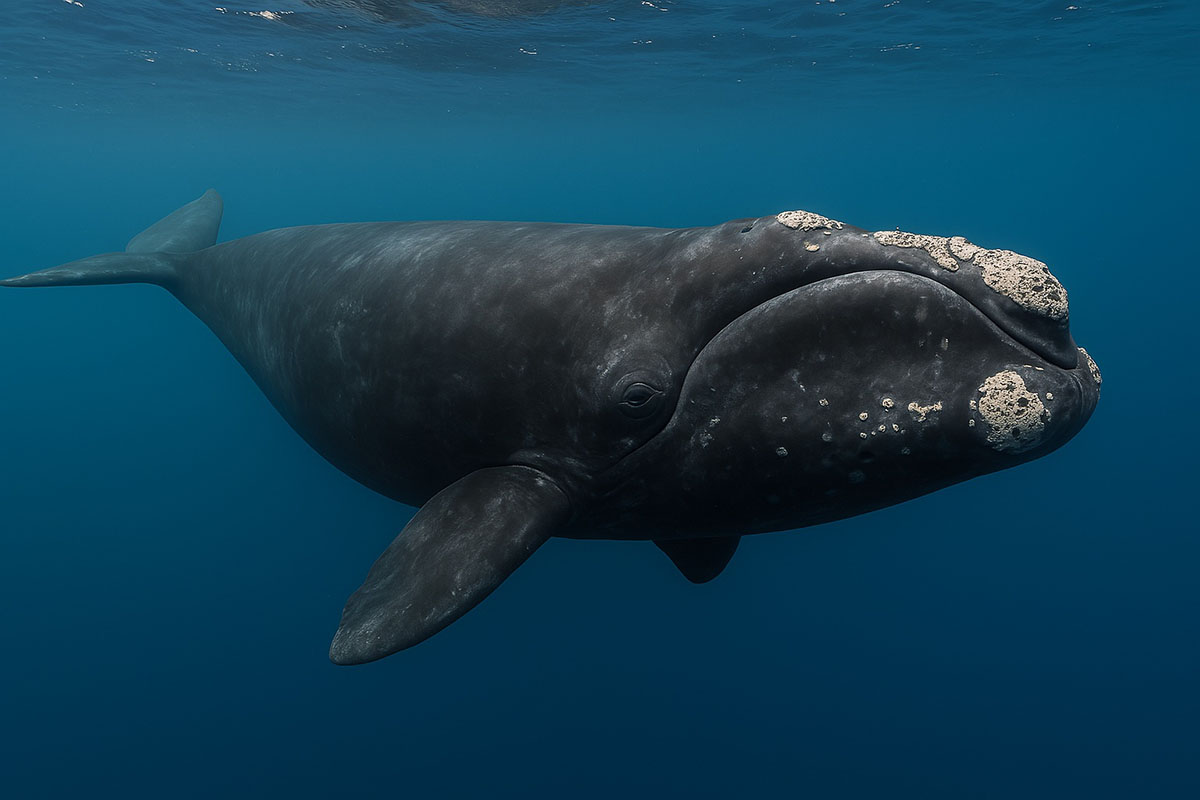
The critically endangered North Atlantic right whale. Credit: Save LBI (generated with AI tools)
Image caption: The critically endangered North Atlantic right whale. Credit: Save LBI (generated with AI tools).

With a population that has dwindled dramatically in recent years, the magnificent right whale is inching perilously close to extinction as it faces a number of ongoing threats. Save LBI filed the petition a year ago on March 31, 2025 requesting NOAA to designate the whale’s primary historic migration corridor a “critical habitat” under the Endangered Species Act (ESA). The corridor identified in the Petition [media.fisheries.noaa.gov/2025-05/NARW-Petition-March-31-2025-508-.pdf] is based on the observation of historical whale migration and the location of its prey.

Notwithstanding multiple follow-up letters, NOAA has not acted on the request, despite the mandated 90-day deadline for doing so. “The deadline for response from the Agency has long since passed so we must go to court,” said Thomas Stavola, Jr., attorney handling the action. “This lawsuit compels NOAA to fulfill its legal duty to consider Save Long Beach Island’s critical habitat petition.”

The primary historic migration corridor designation would require federal agencies to ensure that actions they authorize, fund, or carry out are not likely to destroy or adversely modify the corridor, which is essential to the whale’s migration and survival. It would, in effect, create a vital “missing link” between critical habitats NOAA designated in 1994, and later expanded, to protect the right whale’s feeding grounds off the coast of Maine (and New England) and its calving and nursery grounds off the coast of Georgia and South Carolina. No habitat protections currently exist between these areas in the far north and south, putting the whale’s survival at great risk.

“Only about 380 North Atlantic right whales are believed to remain, which means every preventable impact matters,” explained Denise Boccia, Save LBI Board Member and the primary architect of the petition. “Protecting their connected and continuous primary migration corridor as critical habitat is the most direct, science-based tool we have to keep this species from sliding into extinction.”

WHAT A CRITICAL HABITAT DESIGNATION WOULD DO

If NOAA designates the NARW’s primary historic migration corridor as critical habitat, federal agencies would be required to:

  • Evaluate impacts of major projects—such as large-scale offshore industrial development—on the miles-wide corridor itself.
  • Avoid actions that are likely to destroy or appreciably degrade the whale’s migratory corridor, including activities that create wide-ranging elevated levels of underwater noise across the corridor or appreciably alter the availability of its prey.

A critical habitat designation would deter wind-energy development in lease areas—such as the Atlantic Shores South and North areas off the coast of southern New Jersey—that were unwisely positioned in the whale’s primary migration corridor. Save LBI’s detailed analysis of operational noise from wind-energy complexes (summarized in the Addendum below) reveals that noise from operating wind turbines extends for miles where it remains above levels that disturb the whale’s behavior. “Consequently, those projects could adversely and appreciably affect the miles-wide migration corridor itself and not only seriously impair, but potentially block, the whale’s essential annual migration,” said Save LBI President Bob Stern, a Ph.D. scientist and former manager of the Office of National Environmental Policy Act Affairs for the U.S. Department of Energy.

WHAT THE DESIGNATION WOULD NOT DO

Despite what NOAA has said regarding prior, similar designations, a critical habitat designation for the NARW migration corridor would not:

  • Regulate or restrict vessel traffic: The areas NOAA designates for lower vessel speeds are governed through separate authorities and processes and based on the presence of whales. Whether those areas are labeled critical habitat or not has no bearing on those restrictions.
  • Regulate or restrict commercial or recreational fishing: The designation has no effect on private or state-sanctioned fishing. Federal fishing gear regulations and related measures are governed through separate authorities and processes based on perceived impacts to the whale itself. Any additional measures based on the critical habitat designation would require a separate determination that fishing is likely to destroy or adversely and appreciably modify the miles-wide migration corridor itself, which is not a plausible argument.

ABOUT SAVE LONG BEACH ISLAND, INC.

Save Long Beach Island, Inc. (Save LBI) is a non-profit, non-partisan organization dedicated to protecting the marine environment, coastal ecosystems, and quality of life for residents and visitors of Long Beach Island and the surrounding region. The organization advocates for science‑based, balanced policies that safeguard wildlife, preserve local economies, and promote responsible stewardship of ocean resources. Visit SaveLBI.org for more information.

Contact: https://www.savelbi.org/contact

For more information click here: https://www.savelbi.org

—ADDENDUM: SAVE LBI ESTIMATED NOISE RANGES—

Summary: The Extent of Behavior-Disturbing Noise from Offshore Wind Energy Complexes

Save LBI’s calculations of the noise from wind-turbine complexes proposed in the New York Bight (an area that extends from the southern tip of Cape May, New Jersey, to the southeastern coast of New York’s Long Island) showed that sound levels exceeding the whale’s behavioral disturbance threshold, represented by the red lines in the illustration, extend through the wind complex and for miles from its perimeter (the green line represents all known migration paths, which is wider than the closer-to-shore primary historic migration corridor identified in the petition).
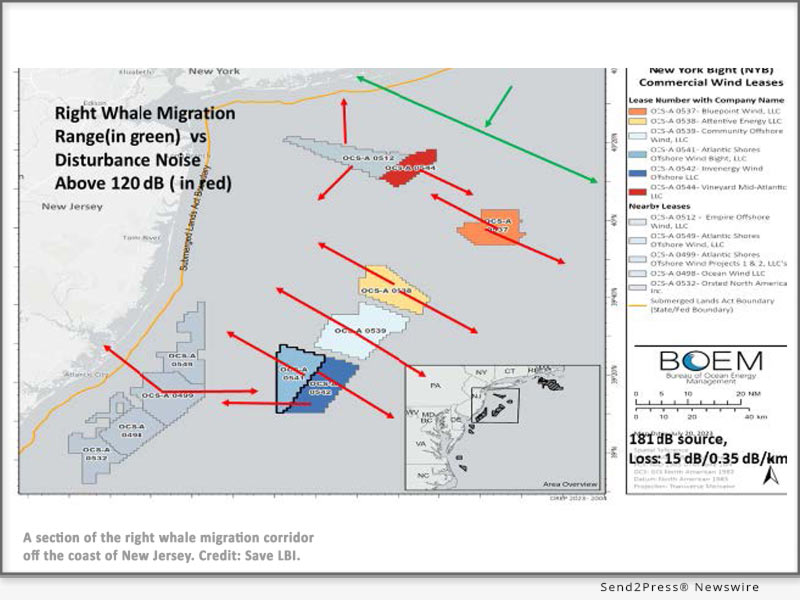
A section of the right whale migration corridor off the coast of New Jersey. Credit: Save LBI.
Image caption: A section of the right whale migration corridor off the coast of New Jersey. Credit: Save LBI.

Some straight-forward math leads to the same conclusion. During wind-turbine construction, noise source levels from pile driving are on the order of 240 decibels (dB). A significant reduction of about 80 dB is necessary to reduce those noise levels to NOAA’s “impulsive-noise behavioral disturbance threshold” of 160 dB. For turbine operation, the aggregate noise source level from a typical complex is about 200 dB, which would also have to be reduced by around 80 dB to meet NOAA’s lower “continuous-noise behavioral disturbance threshold” of 120 dB.

Because both cases require essentially the same 80 dB reduction in noise level, the distances over which sound must travel to drop to acceptable behavioral thresholds is similar. Numerous acoustic analyses conducted by the wind-energy projects have shown that pile-driving noise remains above the acceptable impulsive noise levels for a number of miles beyond the source. So those same multiple-mile ranges are needed to reduce the continuous operational noise generated by the wind complex to the acceptable continuous level, as shown by the red lines in the illustration. Such long distances of elevated noise level create a noise barrier to migration and degrade the viability of the migration corridor itself.

MULTIMEDIA:

IMAGE link for media: https://www.Send2Press.com/300dpi/25-0407-s2p-savelbi-whale-300dpi.jpg

Image caption: The critically endangered North Atlantic right whale. Credit: Save LBI (generated with AI tools).

NEWS SOURCE: Save Long Beach Island (Save LBI)


This press release was issued on behalf of the news source (Save Long Beach Island (Save LBI)), who is solely responsible for its accuracy, by Send2Press Newswire. Image, if any, was provided by the news source and not this website or the wire service. Information is believed accurate, as provided by the news source, but is not guaranteed.

To view the original story, visit: https://www.send2press.com/wire/new-jerseys-save-long-beach-island-sues-noaa-for-failure-to-protect-migration-corridor-of-critically-endangered-north-atlantic-right-whale/

Copr. © 2026 Send2Press® Newswire, Calif., USA. -- REF: S2P STORY ID: S2P135209 NOREL-3B
 

Former DOE NEPA Chief and Save LBI Advocacy President Warns SPEED Act Would ‘Eviscerate’ Environmental Protections and Violate the Constitution

LONG BEACH ISLAND, N.J., March 19, 2026 (SEND2PRESS NEWSWIRE) — Bob Stern, Ph.D., President of Save Long Beach Island (LBI) Advocacy and former manager of the Office of National Environmental Policy Act (NEPA) Affairs for the U.S. Department of Energy (DOE), today issued a sharp warning regarding the Senate’s consideration of the Standardized Permitting and Expediting Economic Development (SPEED) Act. While framed as “permitting reform,” Stern argues the bill is a dangerous overreach that threatens the bedrock of American environmental law and constitutional separation of powers.

Save Long Beach Island (LBI) Advocacy
Image caption: Save Long Beach Island (LBI) Advocacy.

“The SPEED Act does contain some useful deadlines for Agency action but goes way too far and essentially eviscerates the NEPA itself,” Stern said. “This bill ignores the reality that delays are often caused by poor Agency implementation and a failure to fully disclose environmental impacts. In many cases, it isn’t the NEPA vehicle that needs fixing, but rather the ‘nut’ behind the wheel.”

FLAWED IMPLEMENTATION, NOT FLAWED LAW

Only a few agencies have a problem with the National Environmental Policy Act. Stern highlighted the extensive litigation facing the nation’s current offshore wind program as a primary example of implementation failure. He noted that the Department of the Interior (DOI) currently awards lease areas — the most important environmental decision — with virtually no environmental impact information, locking developers into flawed locations and inevitably leading to downstream litigation when environmental problems are brought to light years later in environmental impact statements (EIS), other statutory reviews, and comments by informed stakeholders.

COUNTERPRODUCTIVE REQUIREMENTS

“The bill limits the scope of environmental reviews to the ‘immediate’ and ‘proximate’ effects of a project, dismissing impacts that are caused by the project but separated geographically and timewise,” explained Thomas Stavola Jr. Esq., attorney on behalf of Save Long Beach Island Advocacy. “It also would eliminate the current requirement for an assessment of cumulative impacts. While this may make a consultant’s life easier, it conflicts with well-established case law and the full disclosure requirements of the Act.”

Stavola further noted that “a decision-maker considering such limited information would not be operating in the “real world” and, therefore prone to making flawed decisions, creating more opportunity for litigation and delay.

CONSTITUTIONAL AND LEGAL RED FLAGS

In an extensive markup sent to Senators Sheldon Whitehouse and Martin Heinrich, Save LBI Advocacy identified many provisions in the House-passed version of the SPEED Act that are counterproductive, legally indefensible, and in need of major revision:

  • Citizen Rights: The bill would limit the rights of affected parties to seek relief in Court, which conflicts with the standing prerequisites mandated by Article III of the Constitution. It also conflicts with and violates the Administrative Procedures Act (APA), which holds that a person adversely affected or aggrieved by an agency action is entitled to judicial review.
  • Restrictions on the Courts: The proposed restrictions on vacatur and injunctive relief improperly constrain judicial power and contradict the APA’s clear mandate to “set aside” or vacate unlawful agency actions. By dictating deference to agency judgement of impact, the bill undermines the court’s ability to equitably weigh harms to the parties involved.
  • Conflicts with SCOTUS Precedent: The requirement for “substantial deference” to agencies violates the recent U.S. Supreme Court Chevron deference reversal ruling, which now demands that courts exercise independent judgment in interpreting statutes.
  • Separation of Powers: Provisions that make a court’s remand power contingent on developer consent constitute an unconstitutional impingement on Article III judicial authority.

CONCLUSIONS

“This is not good law,” Stern concluded. “In its present form, the bill creates confusion and does not foster wise decision-making. It would eviscerate NEPA, which has been a bedrock of national environmental policy for over 50 years, and stands in direct conflict with other law and the Constitution itself. Most importantly, the bill does not address the root causes of many delays, which can be fixed with more informed and cooperative applicant and agency staff work.

A CALL FOR CAUTION  

Save LBI Advocacy is calling on the Senators Whitehouse and Heinrich to exercise extreme caution in proceeding with the SPEED Act to be sure they are: (1) addressing the root causes of delay and not creating more chaos and confusion, which will serve no one, and (2) not removing environmental protections that have served us well for over a half-century. To that end, Save LBI Advocacy is asking them to consider its markup of the bill, which can still achieve significant permitting reform while preserving the Act.

ABOUT SAVE LONG BEACH ISLAND ADVOCACY, INC.

Save LBI Advocacy is a non-profit, non-partisan organization dedicated to protecting the shore and ocean environment through rigorous advocacy, ensuring lawful environmental review for offshore industrial development. For more information, please visit https://www.savelbi.org/save-lbi-advocacy.

MULTIMEDIA

LOGO link for media: https://www.Send2Press.com/300dpi/26-0319-s2p-lbiadvocacy-300dpi.webp

NEWS SOURCE: Save Long Beach Island (Save LBI)


This press release was issued on behalf of the news source (Save Long Beach Island (Save LBI)), who is solely responsible for its accuracy, by Send2Press Newswire. Image, if any, was provided by the news source and not this website or the wire service. Information is believed accurate, as provided by the news source, but is not guaranteed.

To view the original story, visit: https://www.send2press.com/wire/former-doe-nepa-chief-and-save-lbi-advocacy-president-warns-speed-act-would-eviscerate-environmental-protections-and-violate-the-constitution/

Copr. © 2026 Send2Press® Newswire, Calif., USA. -- REF: S2P STORY ID: S2P134036 NOREL-3B


Save LBI Outlines New Direction for New Jersey’s Energy Plan, Provides Recommendations for Supplying Affordable, Reliable Electricity While Addressing Climate Change

"For too long, NJ energy planning has been based on slogans and unsupported claims of lower energy cost, job gains, and climate change benefit."

LONG BEACH ISLAND, N.J., Dec. 16, 2025 (SEND2PRESS NEWSWIRE) — Save Long Beach Island, Inc. (Save LBI), a grassroots organization dedicated to sound energy policies and preserving our shore and ocean environment, today released a science-backed research paper to support Governor-elect Mikie Sherrill’s stated goals of “making energy more affordable and reliable” and “driving New Jersey forward with economic development and innovation.”

Save LBI Outlines New Direction for New Jersey's Energy Plan
Image caption: Save LBI Outlines New Direction for New Jersey’s Energy Plan.

Entitled “Shortcomings of the Current New Jersey Energy Master Plan and a New Direction for it,” the 50-page document responds to Governor-elect Sherrill’s call for feedback and recommendations with a constructive, evidence-based critique of the current plan and a series of realistic measures the incoming administration can implement to ensure a reliable, affordable, and long-lasting supply of electricity while pursuing a practical and effective greenhouse-gas (GHG) strategy that does not place undue financial strain on NJ households. The white paper was delivered to Governor-elect Sherrill, members of her transition team, and the New Jersey State Legislature in early December and is available at https://www.savelbi.org/communications.)

“For too long, the State’s energy and climate planning has been based on slogans and unsupported claims of lower energy cost, job gains, and climate change benefit,” said Save LBI president Bob Stern, a Ph.D. scientist with deep expertise in energy and environmental policy. “It’s time for a change — time for New Jersey to move to a cost-effective strategy rooted in reality.”

The latest edition of the State’s Energy Master plan is unfortunately built around the conflicting goals of reducing the cost of electricity and addressing climate change, according to Stern. “Our white paper presents numerical evidence showing that neither of these goals can be met under the current Plan and refutes unsupported claims of energy cost savings, job gains, and real climate change benefit. Most important, we offer ideas for providing reliable and affordable electricity for New Jersey and developing realistic GHG avoidance measures — including a framework for identifying innovative measures that could be deployed widely around the globe — while creating long-term economic opportunity for New Jersey.”

Here’s a summary of the paper’s key conclusions:

  • However well-intentioned, NJ GHG avoidance measures by themselves will have no discernible effect on global climate change. Based on current GHG-emission-trend modeling, even an aggressive New Jersey program would reduce a predicted 26-inch global rise in sea level by only one-hundredth of an inch by the end of the century (see pages 7-9 of the white paper for an eye-opening scientific analysis);
  • New Jersey can have an impact on global climate change and create long-term economic opportunity in the State by redirecting current efforts toward identifying, promoting, and exporting innovative measures that can be adopted widely around the world. A modest statewide GHG reduction program is useful to show that NJ “has skin” in the global
  • The State should accept the reality that some elevation in sea level and other climate impacts are inevitable, but that we have time to deal with them and should start redirecting resources to coastal areas and implementing other resource-protection and -resiliency measures.
  • A reliable, affordable, and long-lasting supply of energy can be achieved in NJ with only a small carbon-emission footprint through the combination of utility-scale solar and nuclear power and low-cost, high-efficiency natural gas.
  • Offshore wind (OSW) projects do not make sense economically or environmentally for NJ, putting them directly at odds with the Governor-elect’s goal of reducing energy OSW projects…
    1. Are by far the costliest means of supplying electricity and guarantee a significant increase in statewide electric bills (pages 4-5 of the white paper provide an apples-to-apples “levelized-cost” comparison of various power generation sources showing the supply cost of offshore wind projects at four times that of combined cycle natural gas and more than twice that of utility-scale solar and nuclear plants);
    2. Are the most expensive and ineffective way of avoiding GHG emissions. Even on a global scale, offshore wind is no panacea. Despite all the attention paid to OSW, it accounts for less than one percent of the world’s electric supply and displaces, at most, one-fourth of a percent of global GHG emissions. For real solutions to the climate problem, a focus on other measures is necessary.
    3. Provide only a limited number of temporary construction jobs for New Jersey workers;
    4. Require back-up systems that are often fossil fuel driven;
    5. Introduce a host of other major tangible problems, including…
      • Significant losses in the State’s bustling tourism sector;
      • Impaired functionality of onshore radar systems used to defend our national airspace;
      • Substantial harm to marine mammals, including the critically endangered North Atlantic right whale;
      • Generation-long blight of the natural seascape and shore because current regulations do not require (or provide funding for) the removal of turbines at the end of their useful life.

“We appreciate Governor-elect Sherrill’s open-minded and collaborative approach to addressing New Jersey’s energy affordability crisis and other important issues,” Stern said. “It is our hope that the evidence presented in this white paper will stimulate reasoned discussions that lead to the adoption of a sound and sensible energy policy — one that that keeps the cost of electricity in check while encouraging innovative approaches to achieving meaningful progress on climate change.”

About Save LBI

Save LBI is a not-for-profit, non-partisan organization that has been active in ongoing litigation and other efforts to protect the coastal and marine environment from the senseless industrialization of our oceans. The organization is led by Beach Haven, N.J. resident Bob Stern, a Ph.D. scientist with experience in environmental planning and environmental law. He is a former manager of the U.S. Department of Energy office responsible for overseeing environmental protection related to energy projects and the Bureau of Air Quality Planning within the New Jersey Department of Environmental Protection (NJDEP). For more information on Save LBI and its efforts, click here: https://www.savelbi.org.

Contact: https://www.savelbi.org/contact

MULTIMEDIA:

Image link for media: https://www.Send2Press.com/300dpi/25-1216-s2p-slbiplan-300dpi.webp

Image caption – Save LBI Outlines New Direction for New Jersey’s Energy Plan

NEWS SOURCE: Save Long Beach Island (Save LBI)


This press release was issued on behalf of the news source (Save Long Beach Island (Save LBI)), who is solely responsible for its accuracy, by Send2Press Newswire. Image, if any, was provided by the news source and not this website or the wire service. Information is believed accurate, as provided by the news source, but is not guaranteed.

To view the original story, visit: https://www.send2press.com/wire/save-lbi-outlines-new-direction-for-new-jerseys-energy-plan-provides-recommendations-for-supplying-affordable-reliable-electricity-while-addressing-climate-change/

Copr. © 2025 Send2Press® Newswire, Calif., USA. -- REF: S2P STORY ID: S2P131795 NOREL-3B


Save LBI Petitions Feds to Rescind Improper 11th-Hour Prior Administration Amendment to Offshore Wind Leases, Impeding their Cancellation

LONG BEACH ISLAND, N.J., Oct. 28, 2025 (SEND2PRESS NEWSWIRE) — Save Long Beach Island, Inc. (Save LBI), a grassroots organization dedicated to sound energy policies and preserving our shore and ocean environment, has petitioned the U.S. Department of Interior (DOI) to rescind amendments to offshore wind leases approved during the final days of the Biden Administration.

Save Long Beach Island, New Jersey (SAVE LBI)
Image caption: Save LBI Petitions Feds to Rescind Improper 11th-Hour Prior Administration Amendment to Offshore Wind Leases.

“In what appears to have been a calculated last-ditch effort to push a faltering offshore wind agenda, the DOI’s Bureau of Ocean Energy Management (BOEM) changed offshore wind leases to effectively create roadblocks that make it more difficult to cancel existing leases,” said Bob Stern, a Ph.D. scientist and president of Save LBI, which has more than 10,000 supporters. “Without any public notice — or comment — new language was inserted into many leases in late December 2024 and January 2025, and the leases were then buried on an obscure government website.”

According to the petition filed on October 20, 2025 and signed by Save LBI and Rhode Island’s Green Oceans, the amended language effectively says an offshore wind lease on the Outer Continental Shelf (OCS) must first be suspended for 5 years before it can be cancelled, and that in the event of cancellation, compensation must be provided to the developer. (The petition is available at savelbi.org: https://www.savelbi.org/_files/ugd/a85a2b_2349c820b1384769a9b64411cf701a5e.pdf.)

“There is a huge problem with BOEM’s amended lease-cancellation language: it violates the renewable energy section of the Outer Continental Shelf Lands Act (OCSLA) enacted by Congress in 2005, which does not contain a 5-year suspension prerequisite for cancellation, nor a compensation stipulation,” Stern explained. “That language applies specifically to oil and gas leases.”

The Save LBI petition states: “If Congress intended to include these limitations and protections in the renewable energy portion of OCSLA, such language would have been incorporated into the statute and regulations, but it was not.”

Save LBI has asked the DOI to immediately rescind the new lease language.

The organizations have also asked DOI to remove prior oil and gas lease cancellation criteria language in the leases that should have been updated in 2016 to “harmonize” with the federal regulations issued then that properly cover the cancellation of renewable energy leases.

“The unfortunate reality is that BOEM’s 11th-hour move to rewrite those leases was one of many egregious actions taken by an Administration determined to push these projects at all costs, regardless of their multifaceted harms and absence of benefit,” said Save LBI attorney Thomas Stavola, adding that Save LBI has challenged those actions in court.

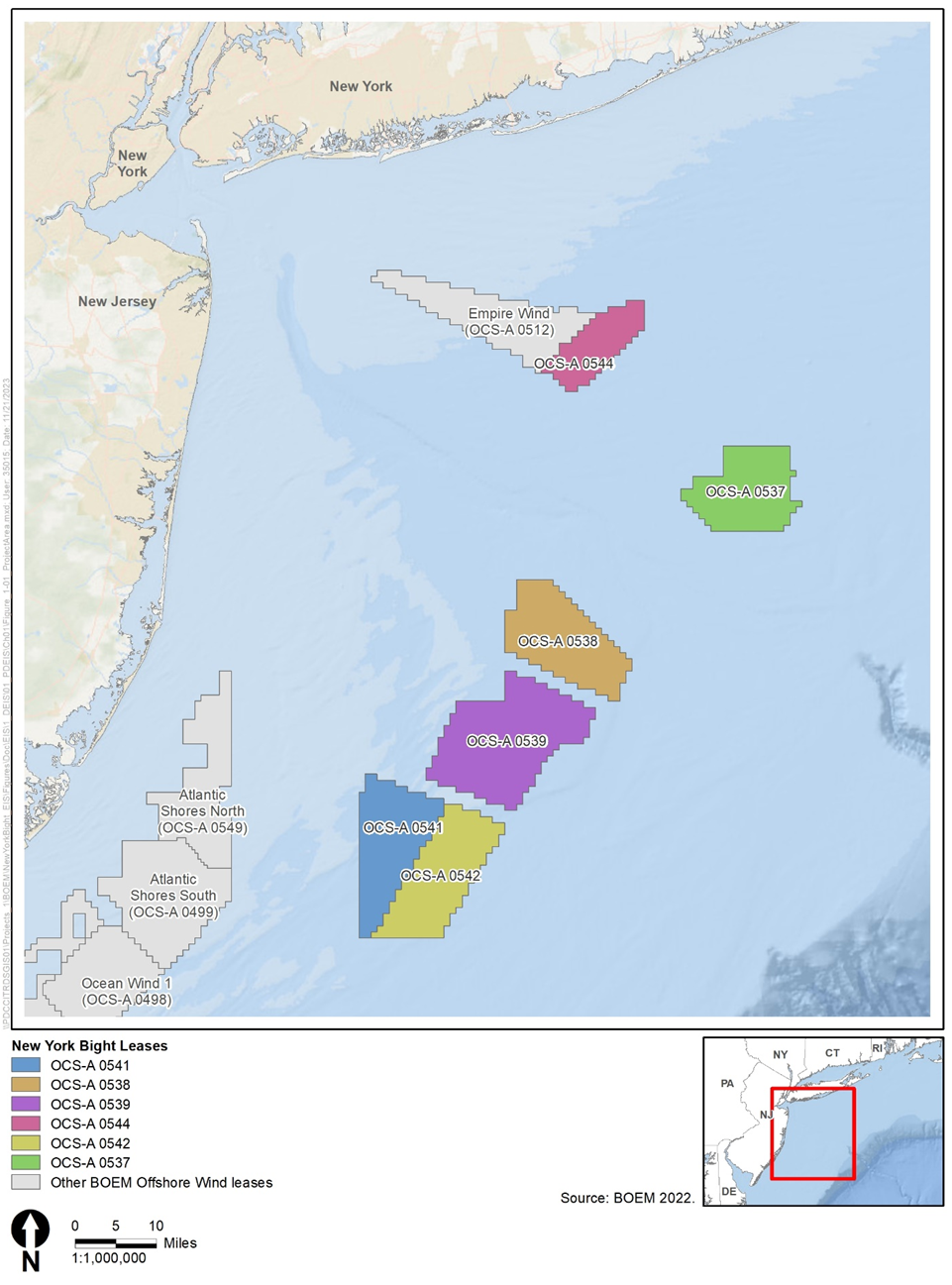
In August, Save LBI formally petitioned the DOI to cancel the leases for the beleaguered Atlantic Shores South and North offshore wind projects and rescind existing permit approvals, citing a series of devastating environmental, social, and economic consequences. (See press release at savelbi.org: https://www.savelbi.org/_files/ugd/a85a2b_7605d6bd935448bdb13b23b7d2491192.pdf.) Plans for those projects call for erecting 357 thousand-foot-tall wind turbines less than 9 miles off the coast of Long Beach Island, Brigantine, and Atlantic City, closer to shore than any large offshore wind project in the world.

“We remain committed to canceling the Atlantic Shores leases,” Stern said. “The many harmful impacts of the Atlantic Shores projects are caused by their uniquely bad location. Location is the most critical factor in the entire decision-making process, yet it received little attention when those sites were approved without full and proper vetting or public input.”

The Department of the Interior has said it intends to propose new rules governing offshore wind lease and project approval. “Save LBI looks forward to offering our expertise to help shape those rules to provide for proper estimation of marine mammal impact, consolidation of leasing and project decisions, and assured turbine removal upon ceasing operation, among other issues,” Stern concluded.

ABOUT SAVE LBI  

Save LBI is a not-for-profit, non-partisan organization that has been active in ongoing litigation and other efforts to protect the coastal and marine environment from the senseless industrialization of our oceans. The organization is led by Beach Haven, N.J. resident Bob Stern, a Ph.D. scientist with experience in environmental planning and environmental law. He is a former manager of the U.S. Department of Energy office responsible for overseeing environmental protection related to energy projects and the Bureau of Air Quality Planning within the New Jersey Department of Environmental Protection (NJDEP). For more information on Save LBI and its efforts, please visit SaveLBI.org.

Contact: https://www.savelbi.org/contact

For more information click here: https://www.savelbi.org

ABOUT GREEN OCEANS

Details are available here: https://www.green-oceans.org/our-story.

LOGO link for media: https://www.Send2Press.com/300dpi/25-1028-s2p-savelbi-300dpi.webp

NEWS SOURCE: Save Long Beach Island (Save LBI)


This press release was issued on behalf of the news source (Save Long Beach Island (Save LBI)), who is solely responsible for its accuracy, by Send2Press Newswire. Image, if any, was provided by the news source and not this website or the wire service. Information is believed accurate, as provided by the news source, but is not guaranteed.

To view the original story, visit: https://www.send2press.com/wire/save-lbi-petitions-feds-to-rescind-improper-11th-hour-prior-administration-amendment-to-offshore-wind-leases-impeding-their-cancellation/

Copr. © 2025 Send2Press® Newswire, Calif., USA. -- REF: S2P STORY ID: S2P130511 NOREL-3B


New Jersey’s Save LBI Calls for Accountability on Offshore Wind Decommissioning, Urges U.S. Dept. of Interior to Reverse Previously Approved Deferrals

LONG BEACH ISLAND, N.J., Oct. 16, 2025 (SEND2PRESS NEWSWIRE) — Save Long Beach Island, Inc. (Save LBI), a grass-roots organization dedicated to sound energy policies and preserving our shore and ocean environment, today urged the U.S. Department of Interior (DOI) to end the egregious practice of letting operators of offshore wind farms postpone providing financial assurance earmarked for the future decommissioning and removal of turbines and related infrastructure.

Save Long Beach Island (Save LBI)
Image caption: Save Long Beach Island (Save LBI).

The organization, which is backed by more than 10,000 supporters, also urged the agency to take two specific actions: 1) Invalidate previous financial assurance deferrals granted to offshore wind projects, compelling developers to provide that assurance soon after turbine operation begins, and 2) mandate that all future renewable energy approvals comply with strict regulations under the Code of Federal Requirements (CFR).

In a letter to DOI Secretary Doug Burgum, Save LBI said the practice of deferring financial responsibility “appears to be pervasive” and cited specific instances where the DOI’s Bureau of Ocean Energy Management (BOEM) authorized the owners of Rhode Island’s Revolution Wind and Massachusetts’ Vineyard Wind projects to postpone payments for 15 years, giving the developers excessive leeway in establishing funding necessary to cover the substantial costs of decommissioning the planned 127 wind turbines off the coast of New England.

Citing one of many examples, the letter — signed by Save LBI attorney Thomas Stavola and Bob Stern, Ph.D scientist and president of the organization — says BOEM authorized a deferral for Revolution Wind on the basis that “providing the full amount of its decommissioning financial assurance prior to receiving any revenue under its power purchase agreements (PPAs) would be an unnecessary and unreasonable financial burden on the company.” However, such revenues are received by the company well before the 15-year deferral given.

A Lack of Accountability

BOEM’s approval of Revolution’s “departure request” ignores CFR requirements, which state, “Any departure approved under this section and its rationale must…be consistent with subsection 8(p) of the OCS Lands Act…[and] protect the environment and the public health and safety to the same degree as if there was no approved departure from this part…”

Calling the approvals “patently absurd,” Stavola said “BOEM abdicated its responsibility to the American people by relying heavily on the ‘financial strength’ of the project instead of upholding its duty to protect the environment, public health, and safety.”

BOEM’s action in the case of Revolution Wind undermines CFR criteria in a number of ways, including:

  • Increasing risk to federal taxpayers, as delineated by the Government Accountability Office (GAO).
  • Foreclosing the possibility of using funds set aside for turbine decommissioning to address unforeseen events — such as Vineyard Wind’s blade failure in the summer of 2024.
  • Heightening the risk that an offshore wind developer will be incapable of meeting financial assurance obligations 15 years down the road, leaving taxpayers to foot the bill.
  • Elevating the possibility of littering the ocean with abandoned offshore wind infrastructure, which could potentially occur after only 10 to 15 years of operation — well before the structure’s official life expectancy. Long-term risks include the potential for derelict turbines, foundations, cables, substations to become hazards for marine wildlife, while leakage of lubricants, hydraulic fluids, and other pollutants contaminates the marine environment.
  • Precluding a key enforcement tool. Without financial assurance, the mechanism that would compel full-site restoration is removed. CFR decommissioning requirements for offshore wind projects include the removal of all facilities, projects, cables, pipelines, obstructions, and clearing the seafloor of all obstructions created by activities authorized under the lease. What’s more, if developers become financially insolvent, regulators lose leverage to enforce compliance.
  • Creating navigational/safety hazards. Abandoned turbines would pose hazards to vessels, fisheries, and navigation, as well as military and commercial radars.
  • Degrading the marine environment in perpetuity. Abandoned turbines will harm marine habitats and interfere with the migration of the critically endangered North Atlantic right whale.

“Beyond the many negatives created by not holding offshore wind developers accountable, there are other fundamental problems,” Stern noted. “It’s not clear what decommissioning means in the context of prior BOEM deferrals or whether the amount of financial assurance specified is up to the task.”

The Save LBI leader stressed the importance of explicitly defining what ‘decommissioning’ means and specifying the level of financial commitment required to fully remediate a site that is no longer active. “Decommissioning could range from merely removing turbine blades to removing the entire turbine tower along with the blades and a subsection of the foundation. We don’t know whether the amount of financial assurance includes onshore storage, processing, and ultimate disposal of materials.”

According to Save LBI estimates, the latter decommissioning effort could cost twice as much as the $325.4 million BOEM assigned to Revolution Wind. The Burgum letter states: “We would suggest that this subject requires major surgery in your upcoming Outer-Continental Shelf rule revisions, and that you consider the following elements in such a revision: a) that turbine removal down to a section of the foundation be required in all cases, b) that a preliminary turbine removal plan and cost be included in the Construction and Operations Plan, c) that BOEM prescribe methods of calculating the cost of turbine removal, including onshore processing and disposal, and, d) that financial assurance begin one year after commencement of operation and be provided for the full cost amount no later than 10 years after commencement of operation.

About Save LBI

Save LBI is a not-for-profit, non-partisan organization that has been active in ongoing litigation and other efforts to protect the coastal and marine environment from the senseless industrialization of our oceans. The organization is led by Beach Haven, N.J. resident Bob Stern, a Ph.D. scientist with experience in environmental planning and environmental law. He is a former manager of the U.S. Department of Energy office responsible for overseeing environmental protection related to energy projects and the Bureau of Air Quality Planning within the New Jersey Department of Environmental Protection (NJDEP). For more information on Save LBI and its efforts, please visit SaveLBI.org.

Contact: https://www.savelbi.org/contact

For more information click here: https://www.savelbi.org

NEWS SOURCE: Save Long Beach Island (Save LBI)


This press release was issued on behalf of the news source (Save Long Beach Island (Save LBI)), who is solely responsible for its accuracy, by Send2Press Newswire. Image, if any, was provided by the news source and not this website or the wire service. Information is believed accurate, as provided by the news source, but is not guaranteed.

To view the original story, visit: https://www.send2press.com/wire/new-jerseys-save-lbi-calls-for-accountability-on-offshore-wind-decommissioning-urges-u-s-dept-of-interior-to-reverse-previously-approved-deferrals/

Copr. © 2025 Send2Press® Newswire, Calif., USA. -- REF: S2P STORY ID: S2P130218 NOREL-3B


The Offshore Wind Plot Thickens: Federal Government Announces Intent to Reconsider Prior Approval of Empire Wind 2 Project

WASHINGTON, D.C., Oct. 2, 2025 (SEND2PRESS NEWSWIRE) — In a significant development for coastal communities and marine conservation advocates, the U.S. Department of Justice has informed the federal court in Washington, D.C. that the Bureau of Ocean Energy Management (BOEM) intends to reconsider its prior approval of the Empire Wind 2 offshore wind project. The announcement came in a filing made on September 30, 2025 in response to ongoing litigation brought by Save Long Beach Island, Inc. (Save LBI) and co-plaintiffs, including Save the East Coast, Protect Our Coast Long Island NY (POC-LINY), and other individuals and businesses, challenging previous federal approvals for the Empire Wind project.

Federal Government Announces Intent to Reconsider Prior Approval of New York's Empire Wind 2 Project
Image caption: Save Long Beach Island, Inc. (Save LBI) and co-plaintiffs, including Save the East Coast, Protect Our Coast Long Island NY (POC-LINY).

In its submission, the government stated that BOEM “intends to undertake a reconsideration of its COP [Construction and Operations Plan] approval for Empire Wind 2,” acknowledging that the review could affect the scope of the case and any decision on the pending motions before the Court.

Empire Wind, slated to be located as close as 19 miles off the coast of New Jersey, with 57 wind turbines for Empire Wind 1 (816 MW) and up to 90 wind turbines for Empire Wind 2 (1,260 MW), has faced mounting scrutiny for potential violations of the Marine Mammal Protection Act (MMPA), the Outer Continental Shelf Lands Act (OCSLA), and the National Environmental Policy Act (NEPA).

Meanwhile, New Jersey Congressman Chris Smith has also asked U.S. Defense Secretary Pete Hegseth to pause Empire Wind based on national security concerns stemming from the potential for the wind turbines to interfere with air defense radars. Absent Executive action, the courts will decide the Empire Wind issue.

“This is a major admission by the federal government that its prior approval of Empire Wind 2 cannot stand as is,” said Bob Stern, Ph.D. scientist and president of Save Long Beach Island, Inc. “It strengthens the argument for a pause to the Empire Wind 1 project. The process and methods for presenting impacts were the same for both projects. If Project 2 has legal and scientific flaws, so has Project 1.”

The litigation continues with respect to Empire Wind, as Empire Wind 1 is under construction.

“The government’s reconsideration of Empire Wind 2 is a welcome step, and it functionally weakens the credibility of their defense of Empire Wind 1,” added Thomas Stavola Jr. Esq., attorney for the plaintiffs. “The projects cannot be separated – both approvals are built on the same tenuous legal foundation, and both must be revisited to comply with the law.”

Save LBI and co-plaintiffs Save the East Coast, Protect Our Coast LINY, and other individuals and businesses will continue to press their case in federal court, while urging BOEM to revise the rules for offshore wind approvals to fully address current environmental impact and legal shortcomings.

For more on Save LBI and key co-plaintiffs in the Empire Wind lawsuit, please visit:

Save LBI: https://www.savelbi.org/

Save the East Coast: https://save-the-east-coast.org/

Protect Our Coast – Long Island NY: https://pocliny.org/

LOGO link for media: https://www.Send2Press.com/300dpi/25-1002-s2p-savelbi-300dpi.webp

NEWS SOURCE: Save Long Beach Island (Save LBI)


This press release was issued on behalf of the news source (Save Long Beach Island (Save LBI)), who is solely responsible for its accuracy, by Send2Press Newswire. Image, if any, was provided by the news source and not this website or the wire service. Information is believed accurate, as provided by the news source, but is not guaranteed.

To view the original story, visit: https://www.send2press.com/wire/the-offshore-wind-plot-thickens-federal-government-announces-intent-to-reconsider-prior-approval-of-empire-wind-2-project/

Copr. © 2025 Send2Press® Newswire, Calif., USA. -- REF: S2P STORY ID: S2P129812 NOREL-3B


Feds Respond to Save LBI Lawsuit with Motion to Reconsider Approvals for Massive Atlantic Shores Wind Farm Off the Coast of New Jersey

Fight to cancel beleaguered offshore project is another victory but the fight continues

WASHINGTON, D.C., Sept. 29, 2025 (SEND2PRESS NEWSWIRE) — In a major development for offshore wind oversight and marine environmental protection, the federal government has filed a motion in U.S. District Court for the District of Columbia to remand the Atlantic Shores Offshore Wind Construction and Operations Plan (COP) and Record of Decision (ROD) approvals for the controversial Atlantic Shores South offshore wind project, planned only 8.7 miles east of New Jersey’s coast. The filing comes in direct response to a federal lawsuit brought by Save Long Beach Island, Inc. (Save LBI) and a coalition of individuals, businesses, and nonprofit plaintiffs.

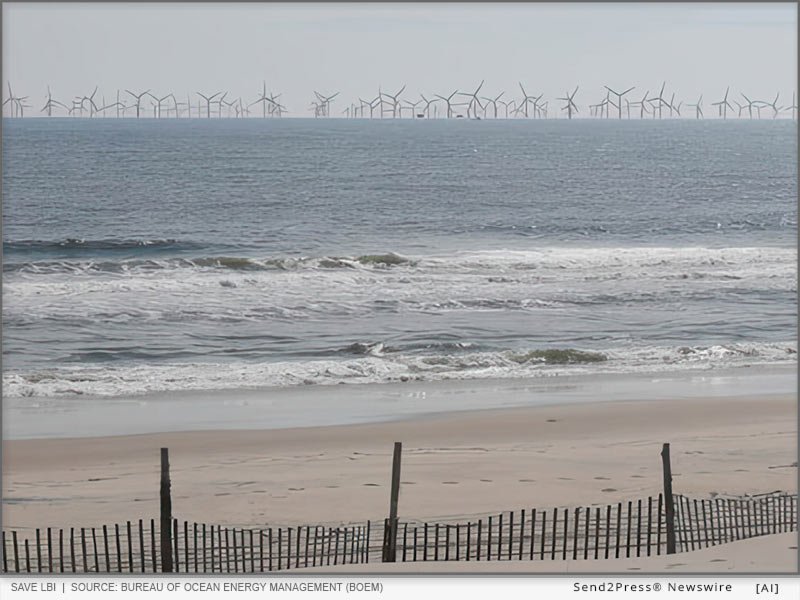
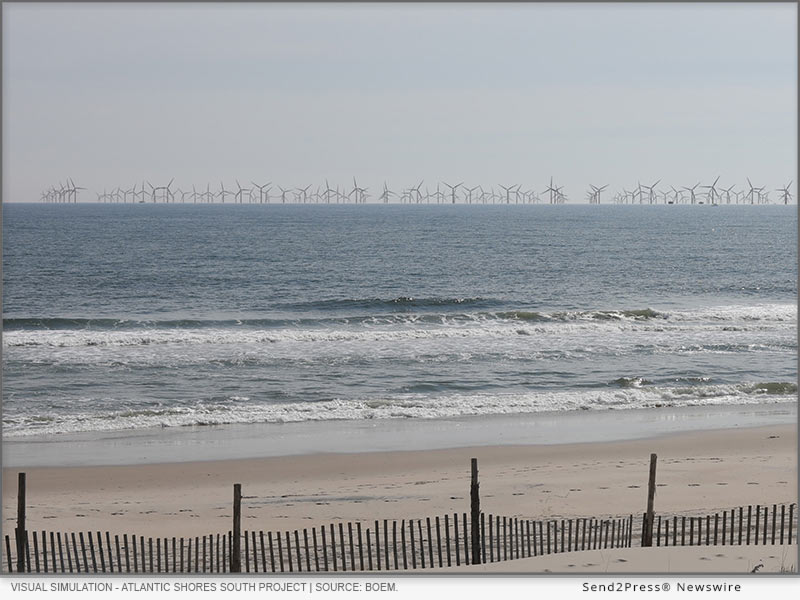
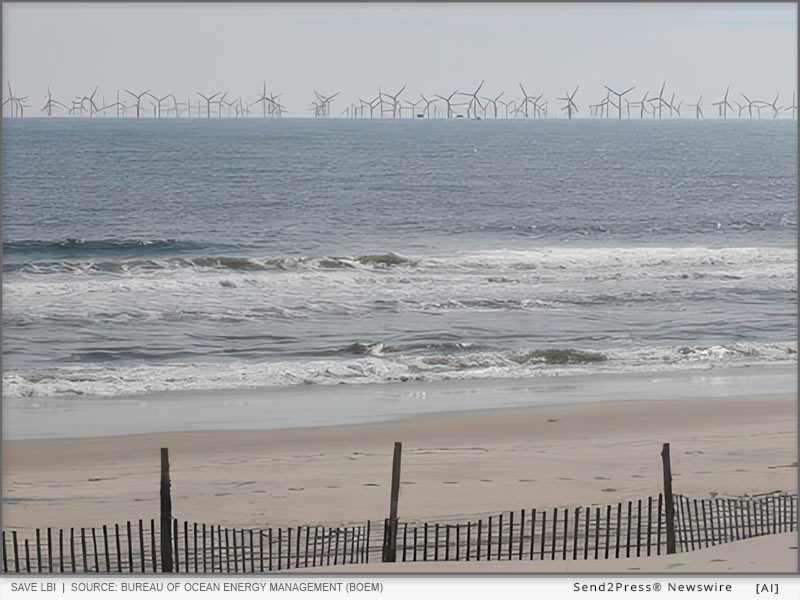
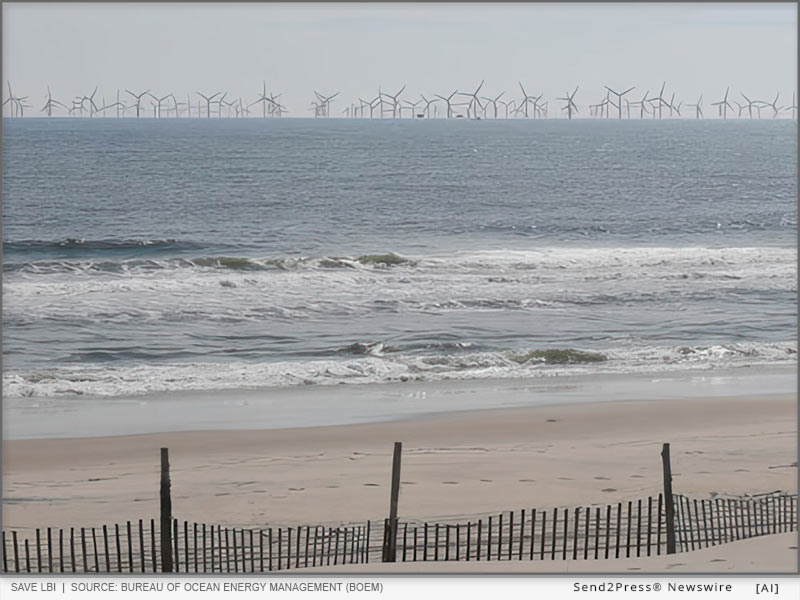
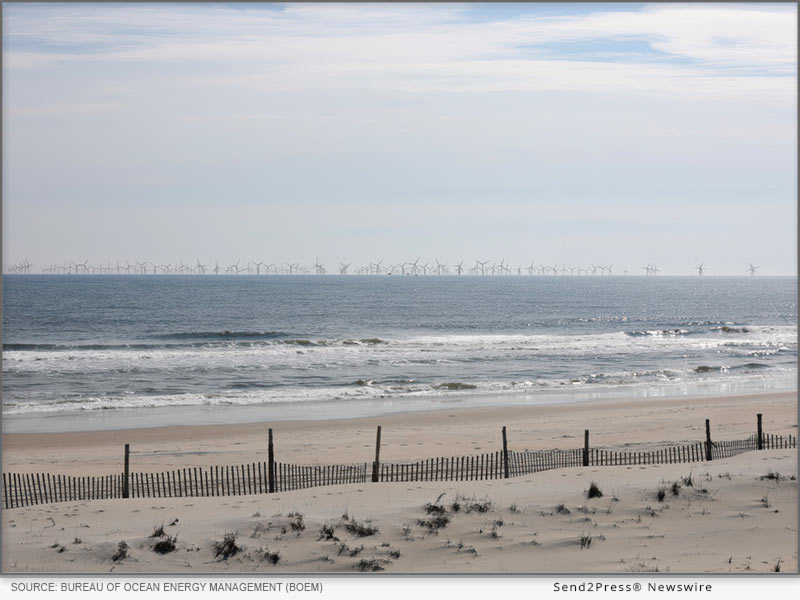
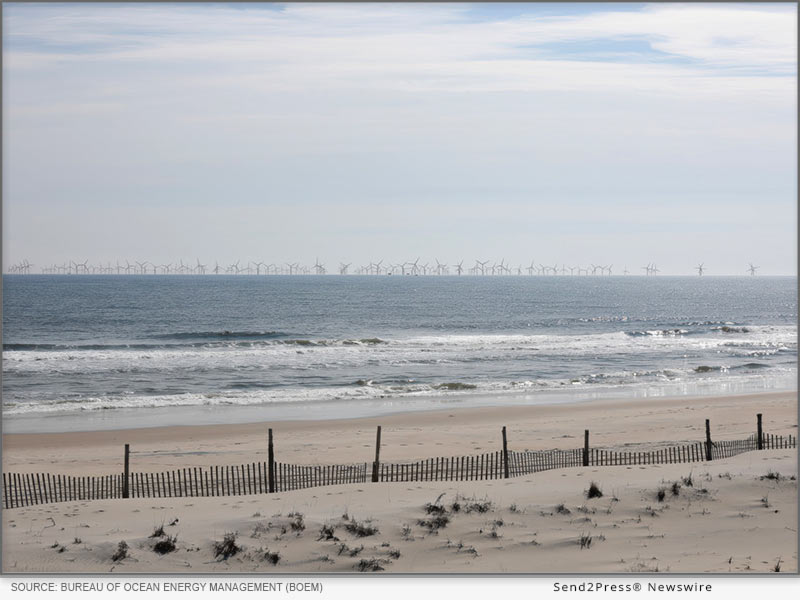
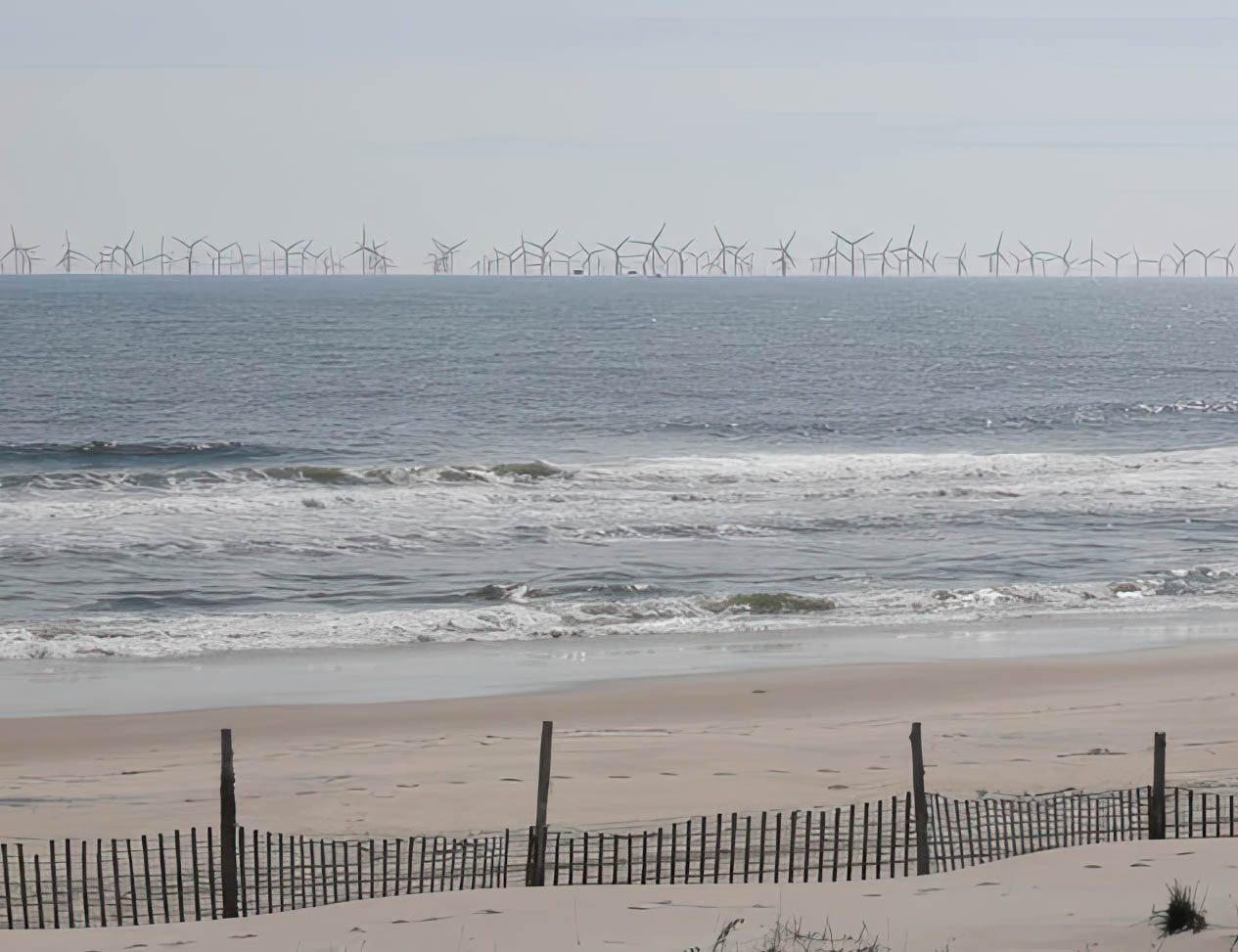
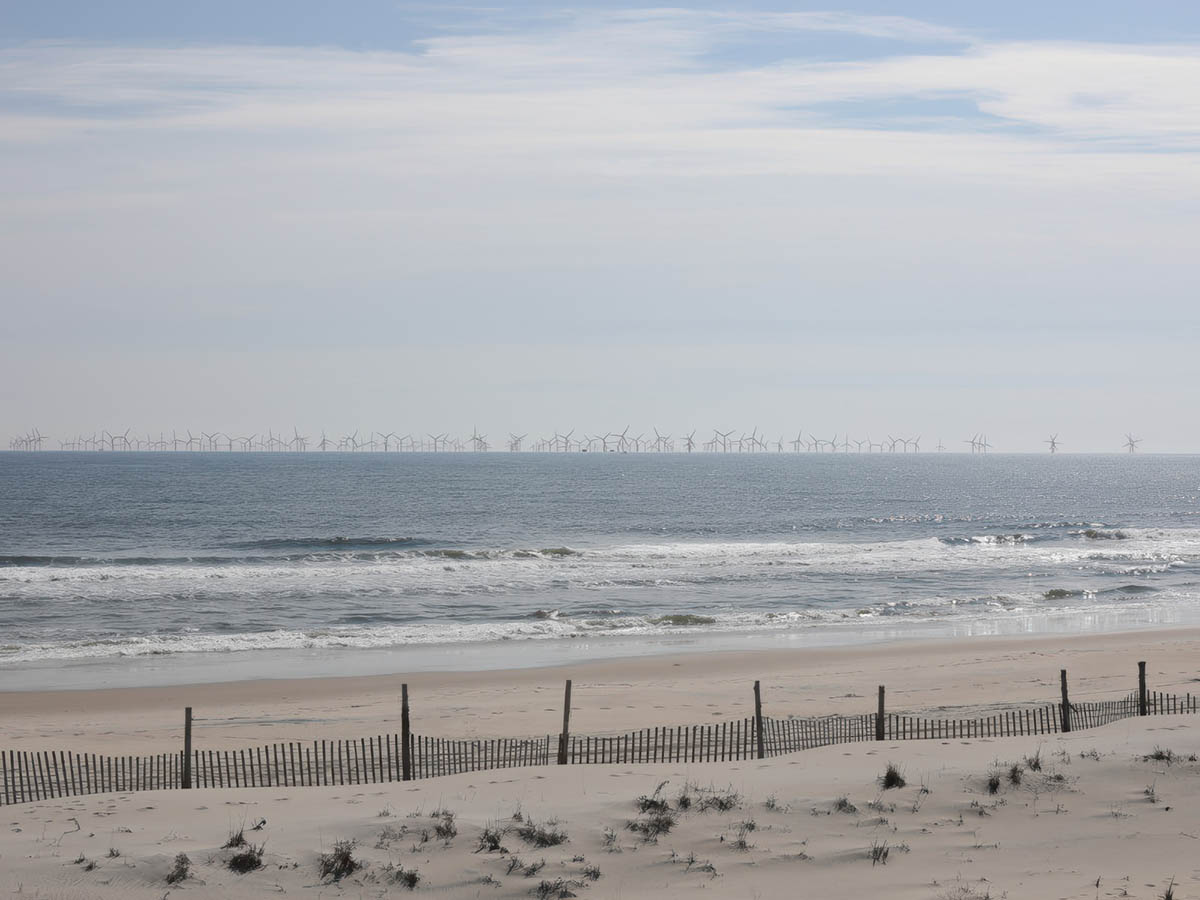
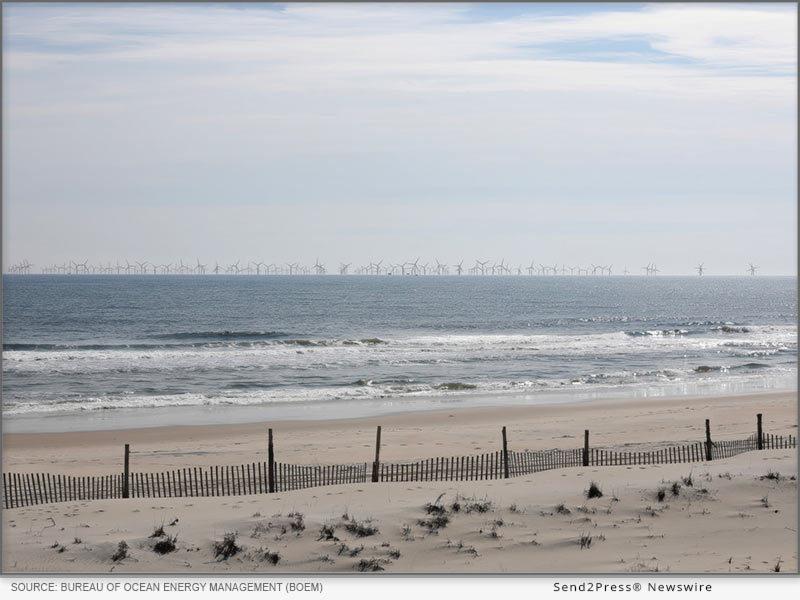
Visual simulation of Atlantic Shores South project - Source: Bureau of Ocean Energy Management
Image caption: Visual simulation of what the Atlantic Shores South project would look from Holgate on Long Beach Island, NJ. Source: Bureau of Ocean Energy Management (BOEM).

The lawsuit — filed on July 11, 2025, in the U.S. District Court for the District of Columbia — challenges the legality of federal approvals granted by the Bureau of Ocean Energy Management (BOEM) and National Marine Fisheries Service (NMFS) under laws including the National Environmental Policy Act (NEPA), Endangered Species Act (ESA), Marine Mammal Protection Act (MMPA), Outer-Continental Shelf Lands Act (OCSLA), Coastal Zone Management Act (CZMA), and the Administrative Procedures Act (APA).

“This filing means federal agencies are going back to the drawing board,” said Bob Stern, Ph.D. scientist and president of Save LBI. “It’s a rare and important moment. It confirms the seriousness of the technical and scientific concerns we’ve raised, for many years now — especially regarding the impacts to endangered North Atlantic right whales and cumulative construction and operation harms to the North Atlantic right whale migration corridor.”

“This is a significant admission by the federal agencies that the Atlantic Shores approvals cannot withstand legal scrutiny in their current form,” said Thomas Stavola Jr. Esq., attorney for Save LBI. “The agencies have now recognized that their environmental review process was flawed and must be revisited. This constitutes a vindication of Plaintiffs’ rights and an acknowledgement of the validity of Plaintiffs’ lawsuit claims.”

The government’s motion requests that the Court remand the COP for Atlantic Shores South so the agencies can reassess the project under governing environmental statutes. That remand effectively dismisses the prior permit approvals granted under those statutes and will likely result in substantial revisions, additional environmental analysis, or a full cancellation of Atlantic Shores’ approval.

The Save LBI and allies’ lawsuit was the first to mount a comprehensive, multi-statute challenge to the Atlantic Shores project, citing data deficiencies, injurious impacts to marine mammals, tourism, economy, and electric rates and failures to assess cumulative impacts across the broader offshore wind buildout.

Today’s motion to remand marks a major inflection point in offshore wind permitting.

The Court will now review the government’s motion and determine whether to grant the remand. While Atlantic Shores currently has most of its federal approvals for the Atlantic Shores South project, earlier this year, Save LBI was responsible for compelling the remand of Atlantic Shores’ Clean Air Act permit to the Environmental Protection Agency (EPA). That permit remains with the EPA.

Save LBI will continue advocating for a full rescission of unlawful approvals, protection of the right whale’s migration, and an overhaul of BOEM and NMFS’s offshore wind permitting practices.

About Save LBI

Save LBI is a not-for-profit, non-partisan organization that has been active in ongoing litigation and other efforts to protect the coastal and marine environment from the senseless industrialization of our oceans. The organization is led by Beach Haven, N.J. resident Bob Stern, a Ph.D. scientist with experience in environmental planning and environmental law. He is a former manager of the U.S. Department of Energy office responsible for overseeing environmental reviews related to energy projects and the Bureau of Air Quality Planning within the New Jersey Department of Environmental Protection (NJDEP). For more information on Save LBI and its efforts, please visit SaveLBI.org.

Contact: https://www.savelbi.org/contact

For more information click here: https://www.savelbi.org

IMAGE LINKS FOR MEDIA:

IMAGE 1: https://www.Send2Press.com/300dpi/25-0805-s2p-slbi-fisheries-300dpi.jpg

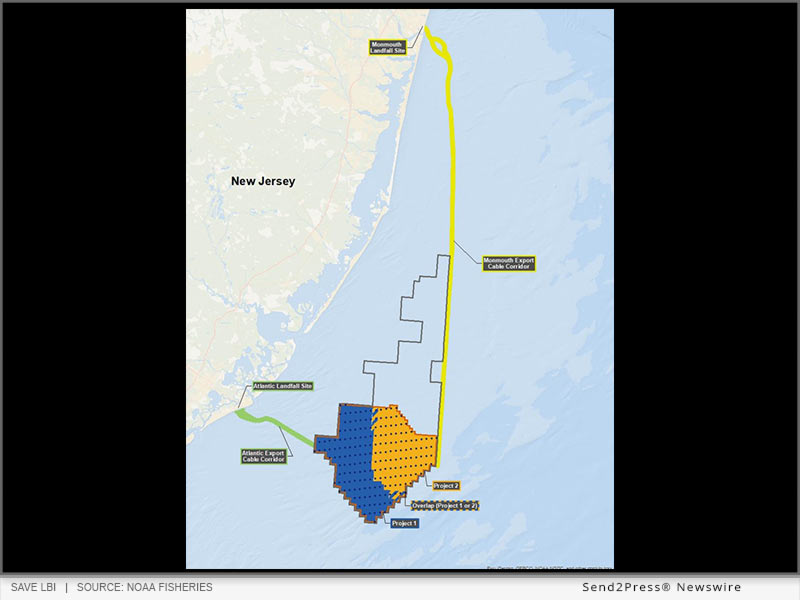
IMAGE CAPTION 1: Atlantic Shores South (blue/orange) and North (outline) lease areas off the coast of Atlantic City and Long Beach Island, NJ. Source: NOAA Fisheries.

IMAGE 2: https://www.send2press.com/300dpi/25-0722-s2p-savelbiboem-300dpi.jpg

IMAGE CAPTION 2: Visual simulation of what the Atlantic Shores South project would look from Holgate on Long Beach Island, NJ. Source: Bureau of Ocean Energy Management (BOEM).

NEWS SOURCE: Save Long Beach Island (Save LBI)


This press release was issued on behalf of the news source (Save Long Beach Island (Save LBI)), who is solely responsible for its accuracy, by Send2Press Newswire. Image, if any, was provided by the news source and not this website or the wire service. Information is believed accurate, as provided by the news source, but is not guaranteed.

To view the original story, visit: https://www.send2press.com/wire/feds-respond-to-save-lbi-lawsuit-with-motion-to-reconsider-approvals-for-massive-atlantic-shores-wind-farm-off-the-coast-of-new-jersey/

Copr. © 2025 Send2Press® Newswire, Calif., USA. -- REF: S2P STORY ID: S2P129669 NOREL-3B
 

New Jersey’s Save LBI Unveils Plan to Secure Reliable and Affordable Electricity, Urges Lawmakers to Act on Escalating Energy Crisis and Reconsider Offshore Wind Development

LONG BEACH ISLAND, N.J., Aug. 26, 2025 (SEND2PRESS NEWSWIRE) — Save Long Beach Island, Inc. (Save LBI), a grass-roots organization with more than 10,000 supporters dedicated to sound energy policies and preserving our shore and ocean environment, today urged the New Jersey Legislature to put politics aside and enact meaningful laws that address the mounting energy crisis and reconsider the role of offshore wind development.

Save Long Beach Island (Save LBI)
Image caption: Save Long Beach Island, Inc. (Save LBI).

The organization is proposing a multifaceted plan that would:

  • Reduce the cost of importing electricity from PJM Interconnection by restoring affordable in-state baseload and high-demand “peaking” capacity.
  • Shield NJ ratepayers from high costs associated with the significant energy demands of AI data centers.
  • Reconsider the role of offshore wind development, a failed experiment that depends on billions of dollars in taxpayer subsidies to deliver intermittent power while destroying the environment and disrupting local shore communities.
  • Demonstrate leadership on greenhouse-gas reduction by increasing in-state nuclear capacity and deploying other carbon reducing measures that could be used worldwide — without mandating artificial renewable-energy quotas.

A Path to Energy Stability

“Delivering reliable, affordable energy is vital to New Jersey residents and businesses and should be the responsibility of all of the State’s elected representatives,” said Save LBI president Bob Stern. “Even before electricity rates jumped 20% in June, New Jersey rates were already among the highest in the nation at 33% above the national average. [*note 1] And two-thirds of that increase is tied to surging data-center demand across the PJM grid system [*note 2] on which the State now heavily relies.”

The State’s reliance on out-of-state power stems from the misguided belief that reliable, in-state “baseload” power could be shut down and replaced by intermittent offshore wind energy that is costly as well as damaging to the environment and local shore communities. Today, New Jersey imports more than 25% of its power (about 5,000 megawatts) [*note 3] from PJM at premium rates. By 2030, demand is projected to rise by another 1,200 megawatts — driven largely by new data centers that require steady baseload power [*note 4] — which will lead to even higher costs and potential supply shortages. [*note 5] (For more background on the impact of current energy policy, see “The Rising Cost of Electricity in New Jersey” on SaveLBI.org.)

“Save LBI is calling on the legislature to assert leadership over the NJ Board of Public Utilities (NJBPU), regardless of who occupies the Governor’s office,” Stern said. “It is the responsibility of our elected representatives — not regulators — to set energy policy.”

Save LBI’s energy plan includes five distinct actions:

  1. Expand nuclear power. New Jersey’s nuclear facilities in Salem and Hope Creek now supply more than 20 percent of the state’s electricity and are critical to maintaining baseload reliability — the ability to generate a continuous supply of electricity across NJ. Several thousand megawatts of capacity could be added to these sites, as well as at the shuttered Oyster Creek Power Station in Lacey Township, by deploying Small Modular Reactors (SMRs) and using existing transmission infrastructure. [*note 3] Under recent licensing streamlining procedures, the SMRs could come online in the 2029 to 2032 time frame.
  2. Deploy natural gas to ensure a reliable supply of energy. Modern combined-cycle and peaking units can deliver thousands of megawatts of reliable power and could be operational within three years.
  3. Reconsider Offshore Wind. In recent years, the industry has faced significant public opposition, escalating costs, and widespread cancellations. Offshore wind projects are heavily dependent on taxpayer subsidies, unable to meet baseload demand, interfere with the accuracy of radar used for national defense and navigation, harm coastal tourism, and pose a serious threat to marine mammals, including the critically endangered North Atlantic right whale, to name a few of the many negatives. Offshore wind is also the most expensive source of energy:
    • The cost per unit (1 megawatt-hour) for offshore wind of power delivered, including grid backup and interconnection costs, is about $300, which is two to almost four times higher than nuclear ($141/MWh for large reactors, $101/MWh for small modular reactors) or combined-cycle gas ($78/MWh). [*note 6]
    • The 20-year cost to New Jersey ratepayers for the current 11,000 MW offshore wind plan is staggering: $101 billion — adding roughly $11,000 per household, $95,000 per commercial user, and $796,000 per industrial user. [*note 7] And these are conservative estimates that reflect outdated, lower pricing and exclude the cost of grid backup.
    • On a percentage basis, the Atlantic Shores South project (off the coast of Long Beach Island, Brigantine, and Atlantic City) alone would increase bills by 11% for residential users, 13% for commercial users, and 15% for industrial users. [*note 8]
    • New Jersey’s full 11,000-megawatt plan would raise average bills by 33 percent in 2035 and 89% in 2045. [*note 9] Again, these estimates are conservative and do not factor in transmission and grid backup costs.
    • State taxpayers have already spent nearly $1 billion to build the unused Paulsboro Offshore Wind Manufacturing Facility and the New Jersey Wind Port staging area in Lower Alloways Creek. Billions more may be needed for turbine removal since current rules do not obligate developers to bear that cost. The U.S. Department of the Interior (DOI) has announced plans to revise leasing and permitting rules — rules that should stipulate turbine removal.
  4. Make data centers pay their fair share. AI/data center demand is a major driver of PJM price increases. Without corrective measures, costs will continue to be unfairly shifted to households. The Legislature should direct BPU to ensure data centers cover the full cost of their demand, including transmission upgrades.
  5. Assume a global leadership position. Climate change is a global challenge. New Jersey alone cannot make a measurable impact, but it can lead by funding a comprehensive study of greenhouse-gas reduction and climate-preparedness strategies that can be deployed worldwide, and then demonstrating and exporting the most promising solutions.

Given the status and history of offshore wind in New Jersey, the Legislature should consider rescinding the Offshore Wind Economic Development Act (OWEDA), which mandates artificial renewable energy goals, or — at a minimum — prohibit new offshore wind procurements until federal rules are revised and a plan for the removal of wind turbines is assured. (Notably, New Hampshire has already cancelled its offshore wind program.)

“All energy sources have their pluses and negatives,” concluded Stern, who served as a manager at the U.S. Department of Energy at a time when the country was looking to reduce its dependency on foreign oil. “Selecting the best mix requires consideration of many factors, including availability, reliability, cost, longevity, and long-term environmental and social impact. Whenever you base policy on just one factor — especially something like climate change that the State can’t meaningfully influence — you run into trouble.”

About Save LBI

Save LBI is a not-for-profit, non-partisan organization that has been active in ongoing litigation and other efforts to protect the coastal and marine environment from the senseless industrialization of our oceans. The organization is led by Beach Haven, N.J. resident Bob Stern, a Ph.D. scientist with experience in environmental planning and environmental law. He is a former manager of the U.S. Department of Energy office responsible for overseeing environmental protection related to energy projects and the Bureau of Air Quality Planning within the New Jersey Department of Environmental Protection (NJDEP).

For more information on Save LBI and its efforts, click here: https://www.savelbi.org.

Contact: https://www.savelbi.org/contact

REFERENCES

  1. U.S. Energy Information Administration: Electric Power Monthly, July 2025, https://www.eia.gov/electricity/monthly/
  2. Regional Plan Association (RPA): What’s happening with electric rates in New Jersey? August 2025, https://rpa.org/news/lab/whats-happening-with-electricity-rates-in-new-jersey
  3. Whitestrand LLC – Wanted: A New Jersey Energy Policy that Works and is Affordable, August 2025, https://whitestrandllc.com/wp-content/uploads/2025/08/Propsed_NJEnergyPolicyReport.pdf
  4. PSE&G 2025 Load Forecast Adjustments, December 2024, https://www.pjm.com/-/media/DotCom/planning/res-adeq/load-forecast/pseg-documentation.pdf and PJM 2025 Long-Term Load Forecast Report, January 2025, https://www.pjm.com/-/media/DotCom/library/reports-notices/load-forecast/2025-load-report.pdf
  5. Tariff Revision for Reliability Resource Initiative by PJM Interconnection LLC (FERC docket ER 25-712-000), December 13, 2024, https://www.lawofrenewableenergy.com/2024/12/articles/energy-policy/ferc/pjm-files-reliability-resource-initiative-at-ferc-requesting-expansion-of-transition-cycle-2-for-reliability-resources/
  6. Whitestrand LLC: A Comparison of the Levelized Cost of Energy (LCOE) of Various Generating Sources, January, 2025, https://whitestrandllc.com/wp-content/uploads/2025/01/LCOE_Study.pdf
  7. Whitestrand LLC: Impact of New Jersey Offshore Wind Program on State Electric Rates, November 2023, https://whitestrandllc.com/wp-content/uploads/2024/04/ImpactOfOffshoreWindOnElectricRatesLBT10.pdf
  8. Whitestrand LLC: Economic Analysis of the Atlantic Shores, South Offshore South Wind Project, August 2024, https://whitestrandllc.com/wp-content/uploads/2024/09/EconomicAnalyisisOf-TheASSouthProject.pdf
  9. Whitestrand LLC: Analysis of the New Jersey Energy Master Plan, May, 2025, https://whitestrandllc.com/wp-content/uploads/2025/05/AnalysisOfNJerseyEMP.pdf

NEWS SOURCE: Save Long Beach Island (Save LBI)


This press release was issued on behalf of the news source (Save Long Beach Island (Save LBI)), who is solely responsible for its accuracy, by Send2Press Newswire. Image, if any, was provided by the news source and not this website or the wire service. Information is believed accurate, as provided by the news source, but is not guaranteed.

To view the original story, visit: https://www.send2press.com/wire/new-jerseys-save-lbi-unveils-plan-to-secure-reliable-and-affordable-electricity-urges-lawmakers-to-act-on-escalating-energy-crisis-and-reconsider-offshore-wind-development/

Copr. © 2025 Send2Press® Newswire, Calif., USA. -- REF: S2P STORY ID: S2P128828 NOREL-3B
 

New Jersey’s Save LBI Applauds Federal Offshore Energy Process Reform, Calls for Early Public Engagement and Major Rule Revisions

LONG BEACH ISLAND, N.J., Aug. 21, 2025 (SEND2PRESS NEWSWIRE) — Save Long Beach Island, Inc. (Save LBI), a grass-roots organization with more than 10,000 supporters dedicated to sound energy policies and preserving our shore and ocean environment, today praised the U.S. Department of the Interior (DOI) Secretary Douglas Burgum for announcing a long overdue overhaul of the federal rules governing offshore renewable energy development on the Outer Continental Shelf (OCS).

Visual simulation of Atlantic Shores South project - Source: Bureau of Ocean Energy Management
Photo caption: Visual simulation of what the Atlantic Shores South project would look from Holgate on Long Beach Island, NJ. Source: Bureau of Ocean Energy Management (BOEM).

The group, which has long raised concerns about a flawed decision-making process that has resulted in unbalanced and environmentally damaging offshore projects, welcomed the Department’s August 7 announcement as a critical step toward restoring transparency, accountability, and alignment with the Outer Continental Shelf Lands Act (OCSLA).

“This reform effort is a clear response to concerns we raised in our July 2025 petition calling for cancellation of the Atlantic Shores South and North lease areas off the coast of Long Beach Island, Brigantine, and Atlantic City,” said Dr. Bob Stern, president of Save LBI. (The petition is available at https://www.savelbi.org/communications.) “We thank Secretary Burgum for his leadership in reexamining a regulatory framework that has failed both communities and the environment.”

In a letter of August 11, 2025, Stern urged the DOI to create an early opportunity for stakeholder engagement — before the draft rules are written — through mechanisms such as an Advance Notice of Proposed Rulemaking (ANPRM). This would allow community advocates, scientists, industry, and local governments to offer innovative solutions while the new regulations are still being shaped, instead of after draft regulatory language is published.

Save Long Beach Island (Save LBI)
Image caption: Save Long Beach Island (Save LBI) logo.

The organization highlighted several key reforms it believes must be included in the new rules:

  • Flip the Wind Energy Area Designation Process: Define off-limits zones for wind development upfront based on clear criteria, such as distance from shorelines, military radar, and whale migration corridors.
  • End Segmented Decision-Making: Require integrated project proposals linking location and project design, evaluated through a single regional environmental impact statement treating all proposals in a region as alternatives, to enable fair, transparent, legally required comparisons.
  • Strengthen Marine Mammal Protections: Establish rigorous, standardized methods for calculating potential harm, developed jointly with the National Oceanic and Atmospheric Administration (NOAA).
  • Mandate Turbine Removal: Require enforceable removal plans and financial assurances to prevent abandoned offshore structures.

“Flawed siting decisions and a dismissive approval process have fueled public outcry,” Stern concluded. “If this rulemaking is to succeed, the process must be transparent, science-based, and responsive to the communities most affected.”

Save LBI pledged to contribute policy expertise and constructive solutions throughout the reform effort.

About Save LBI:

Save LBI is a not-for-profit, non-partisan organization that has been active in ongoing litigation and other efforts to protect the coastal and marine environment from the senseless industrialization of our oceans. The organization is led by Beach Haven, N.J. resident Bob Stern, a Ph.D. scientist with experience in environmental planning and environmental law. He is a former manager of the U.S. Department of Energy office responsible for overseeing environmental protection related to energy projects and the Bureau of Air Quality Planning within the New Jersey Department of Environmental Protection (NJDEP).

For more information on Save LBI and its efforts, click here: https://www.savelbi.org.

Contact: https://www.savelbi.org/contact

MULTIMEDIA:

PHOTO LINK for media:  https://www.send2press.com/300dpi/25-0722-s2p-savelbiboem-300dpi.jpg

PHOTO CAPTION: Visual simulation of what the Atlantic Shores South project would look from Holgate on Long Beach Island, NJ. Source: Bureau of Ocean Energy Management (BOEM).

LOGO link: https://www.Send2Press.com/300dpi/25-0821-s2p-savelbi-logo-300dpi.jpg

NEWS SOURCE: Save Long Beach Island (Save LBI)


This press release was issued on behalf of the news source (Save Long Beach Island (Save LBI)), who is solely responsible for its accuracy, by Send2Press Newswire. Image, if any, was provided by the news source and not this website or the wire service. Information is believed accurate, as provided by the news source, but is not guaranteed.

To view the original story, visit: https://www.send2press.com/wire/new-jerseys-save-lbi-applauds-federal-offshore-energy-process-reform-calls-for-early-public-engagement-and-major-rule-revisions/

Copr. © 2025 Send2Press® Newswire, Calif., USA. -- REF: S2P STORY ID: S2P128624 NOREL-3B
 

New Jersey’s Save LBI Petitions Trump Administration to Rescind Permits and Cancel Leases for Atlantic Shores Offshore Wind Projects

LONG BEACH ISLAND, N.J., Aug. 5, 2025 (SEND2PRESS NEWSWIRE) — Save Long Beach Island (Save LBI), a grass-roots organization with more than 10,000 supporters dedicated to sound energy policies and preserving our shore and ocean environment, has formally petitioned the U.S. Department of the Interior (DOI) to cancel the leases for the Atlantic Shores South and North offshore wind projects and rescind existing permit approvals.

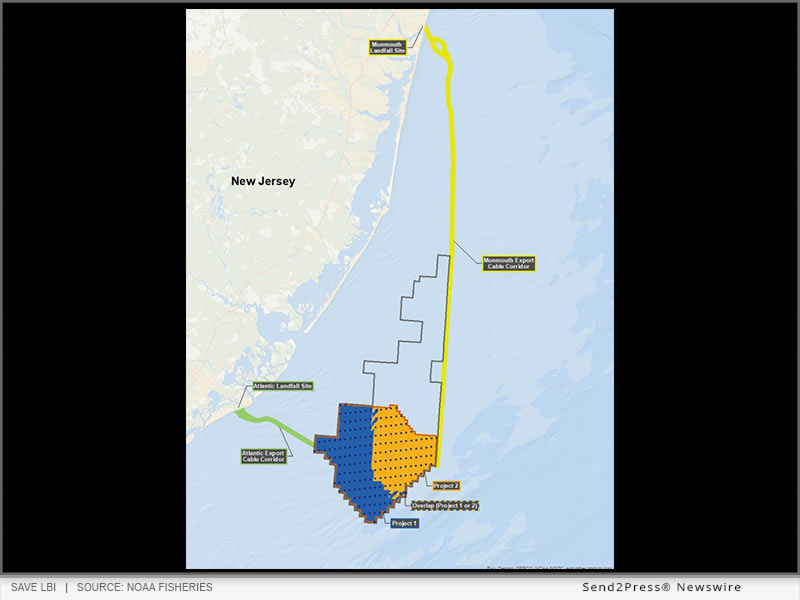
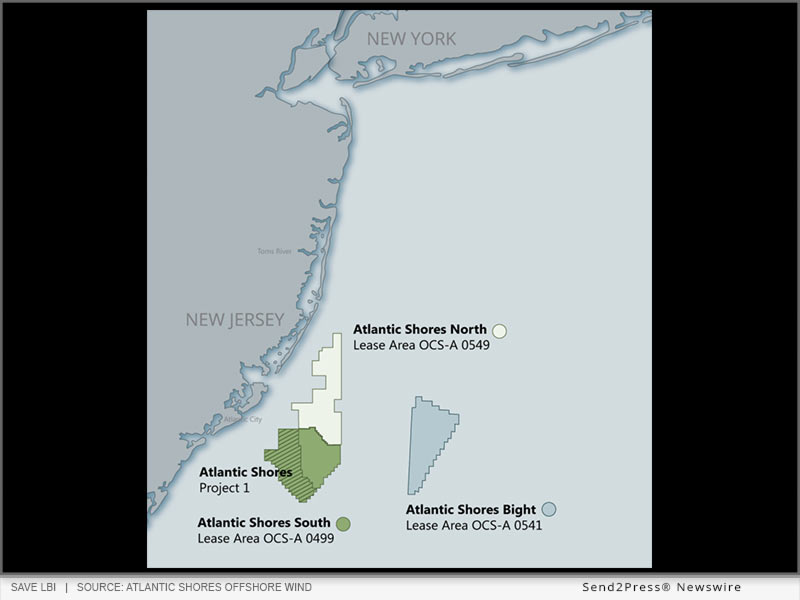
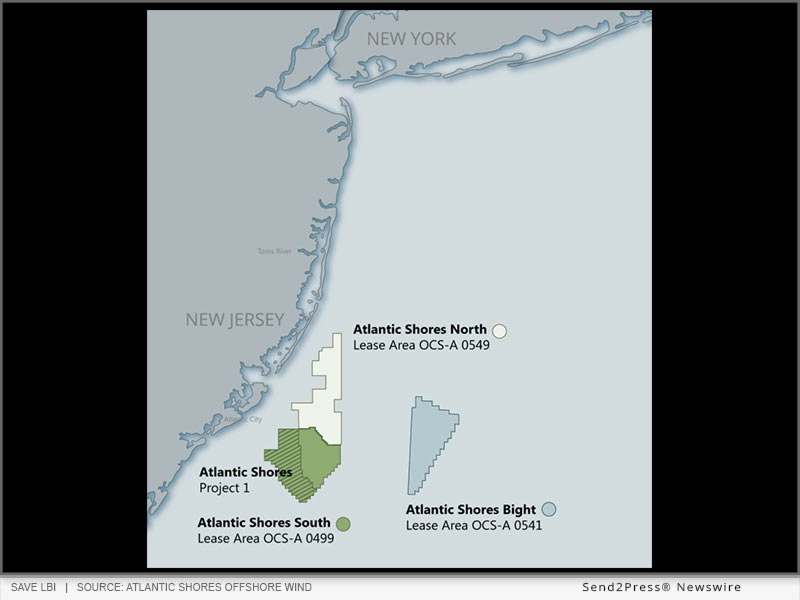
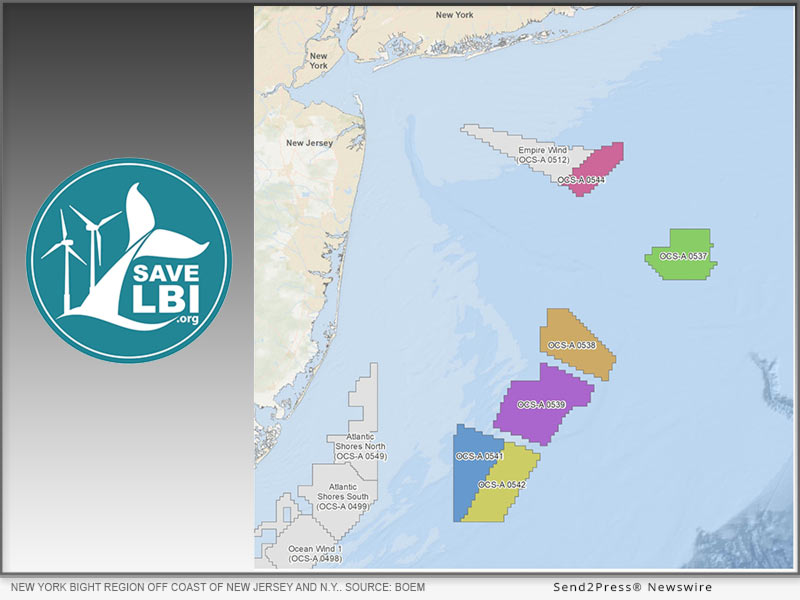
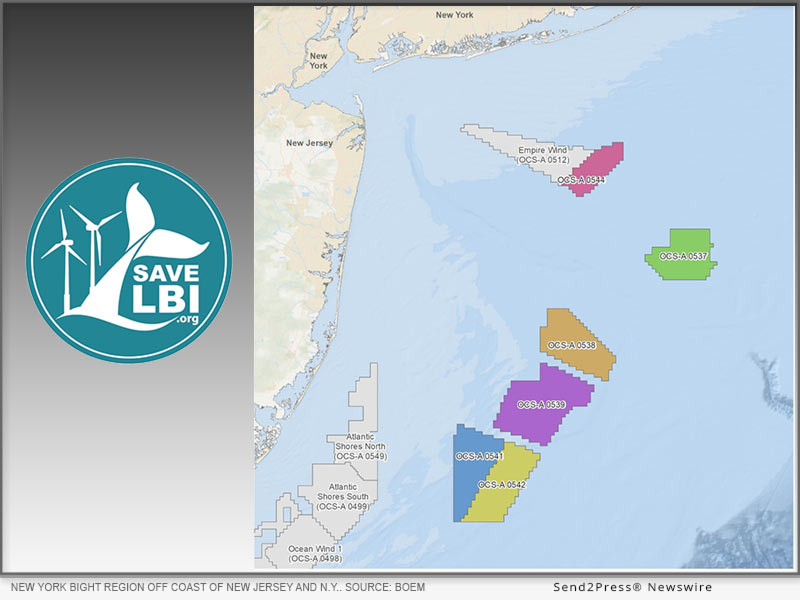
Atlantic Shores South (blue/orange) and North (outline) lease areas off the coast of Atlantic City and Long Beach Island, NJ. Source: NOAA Fisheries.
Image caption: Atlantic Shores South (blue/orange) and North (outline) lease areas off the coast of Atlantic City and Long Beach Island, NJ. Source: NOAA Fisheries.

Save LBI has long opposed both Atlantic Shores projects, which portend a number of devastating environmental, social, and economic consequences for New Jersey coastal communities. Project plans call for erecting 357 thousand-foot-tall wind turbines less than 9 miles off the coast of Atlantic City and Long Beach Island, closer to shore than any large offshore wind project in the world.

To name but a few of the many adverse impacts, these projects would:

  • Degrade the island’s pristine shore environment and lifeblood tourism economy.
  • Obstruct migration of the critically endangered North Atlantic right whale, whose population has dwindled to around 370, all but guaranteeing its extinction.
  • Disturb the behavior of the bottlenose dolphin and significantly reduce its population.
  • Compromise national security by impairing the early warning air-defense radar system at Gibbsboro, NJ.
  • Degrade the pristine air quality at nearby Brigantine National Wilderness Area, which is afforded special federal protections under the Wilderness Act and Clean Air Act.
  • Destroy now submerged archeological sites dating back to the Ice Age, which could shed light on the first humans to come to North America.
  • Substantially increase the already spiraling cost of electricity throughout New Jersey.

FLAWED FROM THE START

Save LBI has contended throughout the approval process and in subsequent litigation that the permits issued to the Atlantic Shores South (OCS-A 0499) and North (OCS-A 0549) projects are seriously flawed. The actual impacts of these projects were misrepresented, systematically underestimated, and not fully disclosed.

“The root cause of the many harmful impacts of the Atlantic Shores projects is their uniquely bad location,” explained Save LBI president and co-founder Bob Stern. “Location is the most critical factor in the entire decision-making process, yet it received little attention many years ago when a DEP-led task force approved those sites without full and proper vetting or public input.”

The record shows that many of the negative consequences Save LBI and others have been publicly denouncing for years were not even considered. “Project modifications cannot cure the uniquely bad siting of these projects, which is why the Atlantic Shores South and North lease areas must be cancelled,” Stern concluded.

The Save LBI petition also reminds DOI Secretary Douglas Burgum of the urgent need to:

  • Implement the Offshore Wind Directive issued by President Trump on January 20, 2025.
  • Address the concerns expressed by candidate Trump raised at a public event in Wildwood, NJ last year.
  • Rescind permit approval under the Endangered Species Act to help prevent extinction of the endangered right whale.
  • Expedite lease cancellation to prevent further whale injuries when the next migration season begins in December.

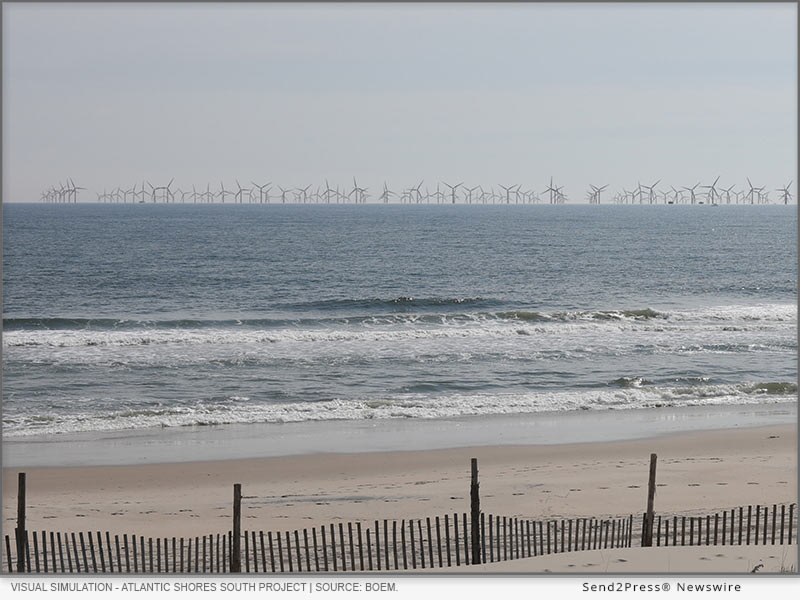
Visual simulation of Atlantic Shores South project - Source: Bureau of Ocean Energy Management
Image caption: Visual simulation of what the Atlantic Shores South project would look from Holgate on Long Beach Island, NJ. Source: Bureau of Ocean Energy Management (BOEM).

The Save LBI petition (available at https://www.savelbi.org/communications) reviews the official criteria for lease cancellation and illustrates how the criteria are met, and how 11 of the 12 legal requirements for such leases are not met. Finally, the petition summarizes more than two decades of incorrect assumptions, mistakes, and process failures in selecting and approving the lease areas. Save LBI believes that these lease areas should not have been approved in the first place, and that if that process is ever started again there is no rational way these leases would be deemed acceptable.

About Save LBI

Save LBI is a not-for profit, non-partisan organization that has been active in ongoing litigation and other efforts to protect the coastal and marine environment from the senseless industrialization of our oceans. The organization is led by Beach Haven, N.J. resident Bob Stern, a Ph.D. scientist with experience in environmental planning and environmental law. He is a former manager of the U.S. Department of Energy office responsible for overseeing environmental protection related to energy projects and the Bureau of Air Quality Planning within the New Jersey Department of Environmental Protection (NJDEP). For more information on Save LBI and its efforts, please visit SaveLBI.org.

Contact: https://www.savelbi.org/contact

For more information click here: https://www.savelbi.org

Link (Save LBI Lease Cancellation Petition): https://www.savelbi.org/communications

IMAGE LINKS FOR MEDIA:

IMAGE 1: https://www.Send2Press.com/300dpi/25-0805-s2p-slbi-fisheries-300dpi.jpg

IMAGE CAPTION 1: Atlantic Shores South (blue/orange) and North (outline) lease areas off the coast of Atlantic City and Long Beach Island, NJ. Source: NOAA Fisheries.

IMAGE 2: https://www.send2press.com/300dpi/25-0722-s2p-savelbiboem-300dpi.jpg

IMAGE CAPTION 2: Visual simulation of what the Atlantic Shores South project would look from Holgate on Long Beach Island, NJ. Source: Bureau of Ocean Energy Management (BOEM).

NEWS SOURCE: Save Long Beach Island (Save LBI)


This press release was issued on behalf of the news source (Save Long Beach Island (Save LBI)), who is solely responsible for its accuracy, by Send2Press Newswire. Image, if any, was provided by the news source and not this website or the wire service. Information is believed accurate, as provided by the news source, but is not guaranteed.

To view the original story, visit: https://www.send2press.com/wire/new-jerseys-save-lbi-petitions-trump-administration-to-rescind-permits-and-cancel-leases-for-atlantic-shores-offshore-wind-projects/

Copr. © 2025 Send2Press® Newswire, Calif., USA. -- REF: S2P STORY ID: S2P128255 NOREL-3B
 

New Jersey’s Save LBI Urges Large Environmental Groups to Reconsider Support of Offshore Wind & Consider Alternatives for Reducing Greenhouse Gas

LONG BEACH ISLAND, N.J., July 22, 2025 (SEND2PRESS NEWSWIRE) — Save Long Beach Island (Save LBI), a grass-roots environmental organization dedicated to protecting our ocean and shore communities, is urging the country’s large environmental organizations to take a step back and critically examine their support of offshore wind energy.

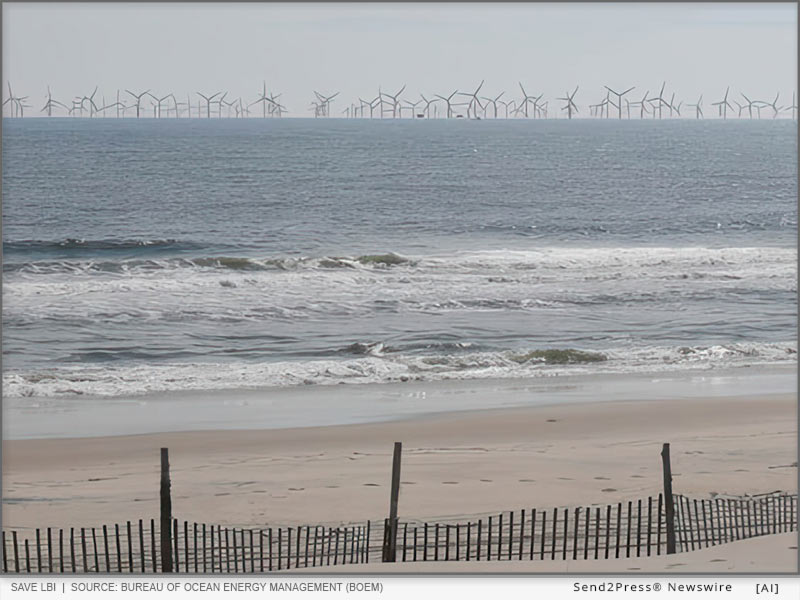
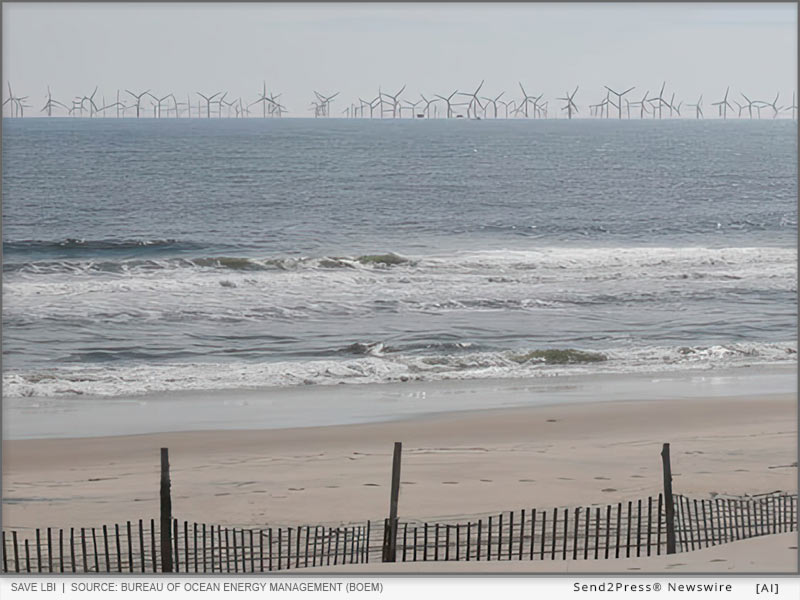
Visual simulation of what the Atlantic Shores South project would look from Holgate on Long Beach Island, NJ. Source: BOEM.
PHOTO CAPTION: Visual simulation of what the Atlantic Shores South project would look from Holgate on Long Beach Island, NJ. Source: BOEM.

In a letter to key executives at The Natural Resources Defense Council (NRDC), the Sierra Club, and more than a dozen other national environmental organizations, Save LBI President and Ph.D. scientist Bob Stern challenged the stance that the benefits of offshore wind energy outweigh the environmental impacts, asserting that relying on massive fields of offshore turbines to reduce greenhouse gas (GHG) emissions is inefficient, environmentally destructive, and the most expensive option on a cost-per-ton-to-remove basis.

“Our membership, like yours, would like to see progress made on the climate change problem, but at the same time we are bitterly opposed to the [Atlantic Shores] offshore wind project we know you support,” wrote Stern, a former manager of the U.S. Department of Energy office overseeing environmental protection related to energy programs and projects. “We bring our concerns not to create more discord but… to ask you to take the time to consider these concerns, with a goal perhaps of moving beyond offshore wind and looking at better ways to reduce greenhouse gas emissions.

“Like many in and around the Long Beach Island (LBI) community, I was stunned when I learned of the Atlantic Shores plan to develop an industrial complex of 1,000-foot-tall turbines starting less than 9 miles off the coast of Atlantic City and LBI, directly in the historic migration path of the critically endangered North Atlantic right whale, closer to shore than any similar project on Earth, and near the Brigantine Natural Wilderness Area and Edwin B. Forsythe National Wildlife Refuge, both of which are afforded special federal protection under the Wilderness Act and Clean Air Act. It is, frankly, astounding that the Bureau of Ocean Energy Management (BOEM) would 1) approve a lease area for commercial wind-energy development adjacent to the shoreline line of a thriving beach community let alone a sensitive nature preserve and 2) grant (without full and proper vetting) the approvals needed to construct the first 200 of a planned 357 super-sized wind turbines that would extend the full length of the island.”

Stern urged the environmental leaders to read Save LBI’s new report, “The Benefits and Risks of an Offshore Wind Project,” which cites independent research exposing a series of irreparable environmental, economic, and social consequences that were either ignored or obfuscated in official project documentation from offshore wind developers and government agencies. The report details many negative impacts of offshore wind, reveals how claims of reductions in GHG emissions are oversimplified and misleading, and presents data showing that offshore wind projects cannot stop or reduce sea level rise — only delay whatever is coming by a matter of days. The document also exposes the hypocrisy in Environmental Impact Statements for the Atlantic Shores (New Jersey), Vineyard Wind (Massachusetts), and Revolution Wind (Rhode Island) projects, all of which concede that the impact of these projects on climate change is “negligible.”

Environmental repercussions outlined in the report include:

  • Harming and killing marine mammals at unprecedented numbers.
  • Creating significant underwater noise from large turbine operation that interferes with historic whale-migration patterns, all but guaranteeing extinction of the critically endangered North Atlantic right whale.
  • Disturbing the behavior of the bottlenose dolphin and reducing its population.
  • Putting air quality in the Brigantine Wilderness Area at risk of “significant deterioration.”
  • Creating significant noise onshore, which during atmospheric inversions would produce indoor noise levels linked to sleep loss and other health issues.

Additional negative impacts include:

  • Compromising national security by impairing the accuracy of NORAD early-warning air defense radar systems.
  • Further increases in the already spiraling cost of electricity, as documented in a 2024 Whitestrand Consulting study showing that the suspended Atlantic Shores South alone would increase electric rates throughout New Jersey, hiking residential rates by 11%, commercial rates by 13%, and industrial rates by 15% to pay for the massive government subsidies awarded to build the project.
  • The absence of a legal or regulatory requirement to remove the towers, blades, and turbine foundations at the end of a wind turbine’s useful life, and no dedicated funding source for such an operation, potentially leaving navigation risks, the loss of fishing grounds, visual blight, and ocean/shore contamination for generations to come.
  • Destroying ancient archeological sites dating back to the Ice Age, which could shed light on the first humans to come to North America.

An Executive Summary and the full 23-page Save LBI report, “The Benefits and Risks of an Offshore Wind Project,” are available at savelbi.org. Click here to download: https://www.savelbi.org/benefits-risks

“We are certainly not climate-change deniers, nor are we aligned with any political Party,” Stern concluded. “We are in favor of using common sense practices and well-grounded science to select sources of clean energy that are both reliable and responsible. There are significant opportunities for reducing greenhouse gas emissions that are far less expensive and environmentally damaging than offshore wind. We welcome the opportunity to engage in meaningful dialogue or perhaps collaborate with you to fund new studies to achieve that goal.”

About Save LBI

Save LBI is a not-for profit, non-partisan organization based on New Jersey’s Long Beach Island that has been active in ongoing litigation and other efforts to protect the coastal and marine environment from the senseless industrialization of our oceans. The organization is led by Beach Haven, N.J. resident Bob Stern, a Ph.D. scientist with experience in environmental planning and environmental law. He is a former manager of the U.S. Department of Energy office responsible for overseeing environmental protection related to energy projects and the Bureau of Air Quality Planning within the New Jersey Department of Environmental Protection (NJDEP). For more information on Save LBI and its efforts, please visit SaveLBI.org.

Contact: https://www.savelbi.org/contact

For more information click here: https://www.savelbi.org

MULTIMEDIA:

PHOTO LINK for media: https://www.Send2Press.com/300dpi/25-0722-s2p-savelbiboem-300dpi.jpg

PHOTO CAPTION: Visual simulation of what the Atlantic Shores South project would look from Holgate on Long Beach Island, NJ. Source: BOEM.

NEWS SOURCE: Save Long Beach Island (Save LBI)


This press release was issued on behalf of the news source (Save Long Beach Island (Save LBI)), who is solely responsible for its accuracy, by Send2Press Newswire. Image, if any, was provided by the news source and not this website or the wire service. Information is believed accurate, as provided by the news source, but is not guaranteed.

To view the original story, visit: https://www.send2press.com/wire/new-jerseys-save-lbi-urges-large-environmental-groups-to-reconsider-support-of-offshore-wind-consider-alternatives-for-reducing-greenhouse-gas/

Copr. © 2025 Send2Press® Newswire, Calif., USA. -- REF: S2P STORY ID: S2P127908 NOREL-3B
 

Save LBI Petitions Federal Agencies to Create a Safe Migration Corridor from Georgia to Maine to Save the North Atlantic Right Whale from Extinction

LONG BEACH ISLAND, N.J., April 8, 2025 (SEND2PRESS NEWSWIRE) — Save LBI, the non-partisan organization dedicated to protecting our oceans from the destructive impacts of offshore wind projects, has filed a petition urging the U.S. Department of Commerce (DOC)/National Marine Fisheries Service (NMFS) and Department of the Interior (DOI)/Bureau of Ocean Energy Management (BOEM) to create a safe migration corridor from Maine to Georgia that will allow the critically endangered North Atlantic right whale (NARW) to survive as a species.

The critically endangered North Atlantic right whale. Credit: Save LBI (generated with AI tools)
Image caption: The critically endangered North Atlantic right whale. Credit: Save LBI (generated with AI tools).

With a population that has dwindled to 340, the magnificent right whale is perilously close to extinction and faces a new, greater and ominous threat from numerous proposed offshore wind-turbine complexes up and down the East Coast.

Save LBI’s 234-page petition seeks to establish a migratory corridor as a critical habitat that would provide a vital “missing link” between critical habitats the NMFS designated in 1994, and later expanded, to protect the right whale’s feeding grounds off the coast of Maine (and New England) and its calving grounds off the coast of Georgia and South Carolina. No habitat protections currently exist between these areas in the far north and south, putting the whale’s survival at great risk.

Central to the petition is the call to prohibit offshore wind development within the proposed protected zone and to establish a buffer that would allow noise from any nearby wind turbines to dissipate and drop below levels known to disturb the whales.

“Restricting the development of offshore wind projects in the migration path of the North Atlantic right whale is crucial to preventing its extinction,” explained Bob Stern, president and co-founder of Save LBI. “Our petition defines the whale’s primary historic migration corridor and presents calculations showing how operational noise from the numerous proposed offshore wind turbine complexes will at a minimum seriously impair and potentially block its annual migration. Without a protected migration corridor and a prohibition on wind complexes in its path, the North Atlantic right whale will not survive.”

Save LBI data reveals that nearly 80 percent of NARW deaths between 2000 and 2020 occurred within the proposed critical habitat migration corridor — even though vessel speed-restriction zones have been in place since 2008.

“Sadly, all efforts to date have not reversed the decline of the right whale,” emphasized Stern, an experienced Ph.D. engineer who managed the U.S. Department of Energy office overseeing environment protection related to energy programs. “The threat is real. The Atlantic Shores South and North projects less than 9 miles off the coast of southern New Jersey, and others like it, are sited directly in the whale’s migratory path, which will accelerate and ultimately seal its extinction unless we act.” (For more on the Atlantic Shores projects and Save LBI’s actions related to those projects, click here: https://www.savelbi.org/press-releases.)

The Save LBI petition also seeks new federal rules that would:

  • Cancel wind-energy lease areas within the corridor consistent with the designation of a critical migration habitat.
  • Reinitiate Endangered Species Act [Section 7(a)(2)] consultations where, based on regulation criteria, the designated habitat “may be affected” by a wind project.
  • Establish a dedicated general taxpayer fund to defray potential costs associated with any new restrictions from the critical habitat designation that would otherwise be borne by specific industries, including shipping and fishing enterprises.

Pending the outcome of a rulemaking decision, the Save LBI petition further aims to preserve the proposed migration corridor in the interim by:

  • Pausing all activities associated with placing wind turbines in the designated area.
  • Suspending high-resolution geophysical surveying during the NARW migration season.
  • Reinitiating Endangered Species Act [Section 7(a)] consultations based on “new information revealing effects not previously considered”— in this case, as shown in the petition, major systemic underestimates in the NARW “take number” estimates used to approve Atlantic Shores South and other projects that use the same methods to calculate the number of incidental NARW deaths or injuries likely to occur during construction and operation of an offshore wind-turbine complex.

NARW: A National Treasure

The North Atlantic right whale, also known as the “urban whale,” is one of the largest and longest living animals on earth. This storied creature spends most of its life within 50 miles of the Atlantic coast as it moves gracefully between feeding grounds to the north and calving areas in the south, returning to the same locations annually thanks to its uncanny sense of navigation. Marine mammal migration is one of the great wonders of the world — especially when it involves a rare species such as the NARW — and public fascination is high, which explains the popularity of “whale watching” tours and town festivals up and down the East Coast as well as a preponderance of academic studies devoted to whales. Given a tiny population, every right whale saved is a step toward recovery, and every one lost, a step toward extinction — which is why Save LBI’s well-tailored legal protections are so important.

The Struggle for Survival

“For centuries, humans have failed the North Atlantic right whale — first through near-eradication from whaling and, more recently, through narratives that downplay the risk of offshore wind projects,” said lead researcher and Save LBI board member Denise Boccia.

“The National Marine Fisheries Service and BOEM have approved projects based on flawed and unsupported assumptions that significantly underestimate impacts, while major environmental organizations that protest similar impacts from oil and gas development remain silent or supportive, apparently mistakenly believing offshore wind offers discernible climate benefits. It does not,” Boccia continued. “University researchers who once voiced concern now appear content to pursue grant-funded projects. As a result, the responsibility to act falls to us, and to other groups and people who care about the many resources and natural treasures the ocean has to offer — including the endangered North Atlantic right whale.”

“Save LBI believes its petition provides a sensible approach to protecting the right whale from extinction, while restricting wind turbines from places where they obviously do not belong. Because the proposed migration corridor is relatively close to shore, the turbine prohibitions would also protect shore tourism industries, and avoid interference with our land-based air-defense radar systems. If we as a society want to save the North Atlantic right whale species from extinction, the migratory critical habitat designation is crucial,” Stern concluded.

“Readers are encouraged to express their support for the NARW migratory corridor petition to The White House, the Department of Commerce, and Department of the Interior.”

Contact information is listed below:

:: The White House
1600 Pennsylvania Ave NW
Washington, DC 20500
whitehouse.gov/contact

:: Douglas Burgum, Secretary
U.S. Department of the Interior
1849 C Street, NW, MS-4106
Washington D.C. 20240
(202) 208-3100
x.com/interior
facebook.com/USInterior
Email: Interior_Press@ios.doi.gov

:: Howard Lutnick, Secretary
U.S. Department of Commerce
1401 Constitution Ave, NW
Washington D.C. 20230
x.com/commercegov
facebook.com/Commercegov/
Email: PublicAffairs@doc.gov

About Save LBI
Save Long Beach Island (Save LBI) is an organization of citizens and businesses on and off the Island working together to protect the ocean and Long Beach Island and neighboring communities from the destructive impact of the Atlantic Shores Offshore Wind projects and potentially other offshore wind projects. As a not-for-profit, non-partisan entity, we do not endorse any political candidates but vigorously pursue policies and actions that protect the Island and New Jersey communities. The organization is led by Beach Haven resident Bob Stern, a Ph.D. engineer with experience in environmental law who previously managed the U.S. Department of Energy’s office overseeing environment protection related to energy programs and projects. Visit SaveLBI.org for more information.

Contact: https://www.savelbi.org/contact

For more information click here: https://www.savelbi.org

MULTIMEDIA:

IMAGE link for media: https://www.Send2Press.com/300dpi/25-0407-s2p-savelbi-whale-300dpi.jpg

Image caption: The critically endangered North Atlantic right whale. Credit: Save LBI (generated with AI tools).

NEWS SOURCE: Save Long Beach Island (Save LBI)


This press release was issued on behalf of the news source (Save Long Beach Island (Save LBI)), who is solely responsible for its accuracy, by Send2Press Newswire. Image, if any, was provided by the news source and not this website or the wire service. Information is believed accurate, as provided by the news source, but is not guaranteed.

To view the original story, visit: https://www.send2press.com/wire/save-lbi-petitions-federal-agencies-to-create-a-safe-migration-corridor-from-georgia-to-maine-to-save-the-north-atlantic-right-whale-from-extinction/

Copr. © 2025 Send2Press® Newswire, Calif., USA. -- REF: S2P STORY ID: S2P125378 NOREL-3B
 

EPA Decision to Reevaluate Clean Air Permit for Atlantic Shores Offshore Wind Project Is a Big Win for Save LBI and New Jersey

LONG BEACH ISLAND, N.J., March 21, 2025 (SEND2PRESS NEWSWIRE) — The beleaguered Atlantic Shores South offshore wind project was dealt another major blow on Friday (March 14) when the Environmental Protection Agency’s (EPA) appeals board [*link 1] sent the project’s Clean Air Act permit back to the regional EPA office that issued it for reevaluation. The action was in response to a Save Long Beach Island (Save LBI) petition challenging the merits of the permit approval and requesting further review [*link 2], and follows a string of setbacks for the controversial plan to erect two hundred 1,000-foot wind turbines as close as 8.7 miles off the coast of southern Long Beach Island, Brigantine, and Atlantic City.

The Atlantic Shores South lease area (green) off the coast of NJ spans 286 square miles. Source: Atlantic Shores Offshore Wind.
Image caption: The Atlantic Shores South lease area (green) off the coast of NJ spans 286 square miles. Source: Atlantic Shores Offshore Wind.

“This is a significant event because to my knowledge it is the first time that a federal approval for any offshore wind project has been overturned, and it highlights the lack of full disclosure and questionable science and mathematics that has characterized other applications and approvals,” said Bob Stern, president and co-founder of Save LBI, the non-partisan watchdog group formed in 2021 to protect the ocean and New Jersey Shore communities from the destructive impacts of offshore wind. The move also means the Atlantic Shores South project does not currently have all of the federal approvals it needs to install wind turbines off the coast of New Jersey.

“The Atlantic Shores’ permit contained substantial analytic deficiencies, rendering it non-compliant with the Clean Air Act, so I am pleased to see the EPA recognize the necessity for re-examination,” said Thomas Stavola Jr., the attorney for Save LBI.

Stern, an experienced Ph.D. engineer who managed the U.S. Department of Energy office overseeing environment protection related to energy programs, called the ruling that granted the clean-air permit “deeply flawed.”

For starters, air-quality modeling for the project was not done properly and the State’s Regional Haze Implementation Plan failed to consider emissions from construction and operation of the wind complex, which would be only 9 miles from the protected Brigantine National Wilderness Area and Edwin B. Forsythe National Wildlife Refuge. Stern has long maintained that air pollutants from the construction and ongoing operation and maintenance and repair of those turbines would degrade air quality in a unique and pristine natural environment that is subject to stringent air-quality requirements under the Clean Air Act. In 1977, Congress acknowledged the uniqueness of the Brigantine Wilderness Area by designating it a Class I area and granting it special air-quality and visibility protections under the Clean Air Act.

Visual simulation of Atlantic Shores South project - Source: Bureau of Ocean Energy Management
Image caption: Visual simulation of Atlantic Shores South project from Holgate, New Jersey. Source: Bureau of Ocean Energy Management (BOEM).

A Mountain of Bad News for a Faltering Project

In the weeks leading up to Friday’s EPA air-permit ruling, the prospects of the Atlantic Shores South project grew increasingly dim. On January 13, Save LBI filed a major, first-of-its-kind lawsuit against the U.S. Department of Commerce, National Marine Fisheries Service, Bureau of Ocean Energy Management, U.S. Department of Interior, and Atlantic Shores for violating a number of federal environmental statutes, including the National Environmental Policy Act, the Endangered Species Act, the Marine Mammal Protection Act, the Outer Continental Shelf Lands Act, and the Coastal Zone Management Act.

Within a few weeks, Shell New Energies and EDF Renewables, 50/50 partners in the venture, both paused investment in the project, writing off $2 billion in losses, and the New Jersey Board of Public Utilities (BPU) declined to award the significant additional rate subsidies Atlantic Shores had requested to fund the project.

Despite what appears to be a cataclysmic breakdown in the fortunes of Atlantic Shores, Stern reiterated Save LBI’s resolve to seek a “permanent end” to the Atlantic Shores South and North projects, the latter of which has yet to receive any federal approvals. This includes the passage of federal legislation to remove investment tax credits under the Inflation Reduction Act and the cancellation of these wind lease areas.

“We are hopeful that other federal agencies, particularly the Interior Department and NOAA, will take note of the EPA’s action and reconsider their prior approvals, especially those dealing with marine mammal impact,” Stern concluded, adding, “We have written to both asking for that.”

About Save LBI

Save Long Beach Island (Save LBI) is an organization of citizens and businesses on and off the Island working together to protect the ocean and Long Beach Island and neighboring communities from the destructive impact of the Atlantic Shores projects and potentially other offshore wind projects. As a not-for-profit, non-partisan entity, we do not endorse any political candidates but vigorously pursue policies and actions that protect the Island and New Jersey communities. The organization is led by Beach Haven resident Bob Stern, a Ph.D. engineer with experience in environmental law who previously managed the U.S. Department of Energy’s office overseeing environment protection related to energy programs and projects. Save LBI is fighting to stop the ill-conceived Atlantic Shores projects. Visit SaveLBI.org for more information.

Contact: https://www.savelbi.org/contact

For more information click here: https://www.savelbi.org

* LINKS:

1. EPA Order Granting Motion for Voluntary Remand

https://yosemite.epa.gov/oa/eab_web_docket.nsf/9C7B7CF33923032185258C4D0058F4A7/$File/Atlantic%20Shores%20Order%20Granting%20Motion%20for%20Voluntary%20Remand,%20FINAL.pdf

2. Save LBI Calls Out EPA for Approving Clean Air Permit for Atlantic Shores Offshore Wind Project: https://www.savelbi.org/_files/ugd/a85a2b_9603162138a04835b0c2f5c32b76af8e.pdf

MULTIMEDIA:

Image 1: https://www.Send2Press.com/300dpi/25-0321-s2p-asoffshore-300dpi.jpg

Image 1 Caption: The Atlantic Shores South lease area (green) off the coast of NJ spans 286 square miles. Source: Atlantic Shores Offshore Wind.

Image 2https://www.Send2Press.com/300dpi/25-0113-s2p-savelbi-300dpi.jpg

Image 2 Caption: Visual simulation of Atlantic Shores South project from Holgate, New Jersey. Source: Bureau of Ocean Energy Management (BOEM).

NEWS SOURCE: Save Long Beach Island (Save LBI)


This press release was issued on behalf of the news source (Save Long Beach Island (Save LBI)), who is solely responsible for its accuracy, by Send2Press Newswire. Image, if any, was provided by the news source and not this website or the wire service. Information is believed accurate, as provided by the news source, but is not guaranteed.

To view the original story, visit: https://www.send2press.com/wire/epa-decision-to-reevaluate-clean-air-permit-for-atlantic-shores-offshore-wind-project-is-a-big-win-for-save-lbi-and-new-jersey/

Copr. © 2025 Send2Press® Newswire, Calif., USA. -- REF: S2P STORY ID: S2P124882 NOREL-3B
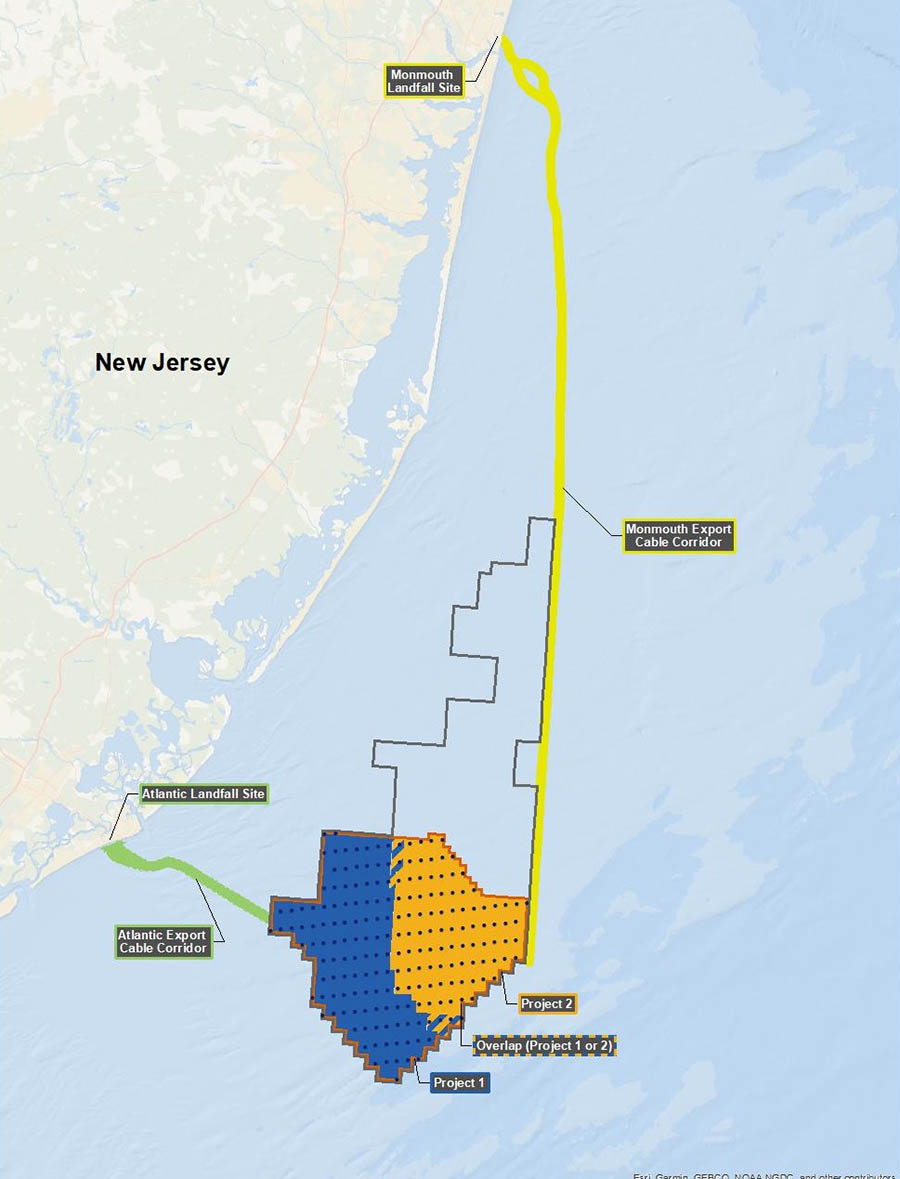
 

Save LBI Encouraged by Collapse of Atlantic Shores Offshore Wind Projects, Presses on with Litigation to Ensure Permanent Victory

LONG BEACH ISLAND, N.J., Feb. 11, 2025 (SEND2PRESS NEWSWIRE) — Save Long Beach Island (Save LBI), the non-partisan watchdog group formed in 2021 to protect the ocean and New Jersey Shore communities from the destructive impacts of offshore wind, announced today that, while it is gratified by the collapse of the controversial Atlantic Shores South projects, the organization will remain vigilant and continue the fight to ensure that these projects and the Atlantic Shores North project are canceled and never return.

Visual simulation of Atlantic Shores South project - Source: Bureau of Ocean Energy Management
Image caption: Visual simulation of Atlantic Shores South project from Holgate, New Jersey. Source: Bureau of Ocean Energy Management (BOEM).

The controversial Atlantic Shores South plan to erect 200 wind turbines as close as 8.7 miles off the coast of southern Long Beach Island (LBI), Brigantine, and Atlantic City, began unraveling on January 30 when Shell New Energies, which owns 50 percent of Atlantic Shores Offshore Wind, announced that it would write off a billion-dollar loss and step away from the projects. The announcement came just 17 days after Save LBI filed a comprehensive federal lawsuit against the projects alleging noncompliance with five laws. Four days later, the New Jersey Board of Public Utilities (BPU) refused to award significant additional rate subsidies that Atlantic Shores had requested to fund the projects.

“This is a major victory for shore values, communities, and common sense,” said Bob Stern, president and co-founder of Save LBI in a letter thanking supporters. “But there is also unfinished business here to ensure that these projects, or similar ones, never reappear, and that the flawed Federal and State processes and impact-assessment methods that carried such a costly and damaging project this far are fundamentally changed.”

Stern identified several areas in which Save LBI will continue its fight to permanently end Atlantic Shores South and Atlantic Shores North, including the passage of federal legislation to remove investment tax credits and other incentives for offshore wind under the Inflation Reduction Act and the cancellation of the two wind lease areas. “We have written to U.S. Department of the Interior Secretary [Douglas] Burgum suggesting that, and will be filing a formal petition asking for cancellation,” Stern said. “Our recent federal lawsuit provides ample justification for such cancellation.”

Save LBI will also seek to overturn prior project approvals through its ongoing litigation — which if granted, would set a precedent for other cases — and continue its longstanding campaign to protect the critically endangered North Atlantic right whale by filing a petition with the National Oceanic and Atmospheric Administration (NOAA) to establish a safe migration corridor along the East Coast. That petition, which asks NOAA to designate the corridor as critical habitat, will demonstrate that the Atlantic Shores projects and other offshore wind projects in these sensitive areas would seriously impede or block whale migration.“ We will ask that all wind projects be excluded from that critical habitat corridor,” Stern said.

Finally, Stern welcomed the new Administration’s review of the leasing and permitting practices for all offshore wind projects and urged everyone involved with Atlantic Shores South to “reflect on how a project with virtually no benefit, high cost, and significant environmental damage proceeded so far. Our work on this over the last few years showed that the entire process of site selection and project review was fundamentally flawed.

“We will continue our efforts to inform the public, the media, and our elected representatives as to the true costs and impacts of these projects, suggest improvements for the leasing, environmental review, and financing practices used, and offer constructive energy supply options to keep the lights on,” Stern concluded.

About Save LBI:

Save Long Beach Island (Save LBI) is an organization of citizens and businesses on and off the Island working together to protect the ocean and Long Beach Island and neighboring communities from the destructive impact of the Atlantic Shores Offshore Wind projects and potentially other offshore wind projects. As a not-for-profit, non-partisan entity, we do not endorse any political candidates but vigorously pursue policies and actions that protect the Island and New Jersey communities.

The organization is led by Beach Haven resident Bob Stern, a Ph.D. engineer with experience in environmental law who previously managed the U.S. Department of Energy’s office overseeing environment protection related to energy programs and projects. Visit SaveLBI.org for more information.

Contact: https://www.savelbi.org/contact

For more information click here: https://www.savelbi.org/

LINKS:

Save LBI Sues U.S. Agencies and Atlantic Shores Offshore Wind, Challenging Federal Approvals Greenlighting Marine Ecosystem Devastation, Including Risks to Critically Endangered Whales

Click here (PDF): https://www.savelbi.org/_files/ugd/a85a2b_ea578a317854424389201d397b96325e.pdf

Save LBI Letter to Supporters

Click here: https://www.savelbi.org/

Save LBI to Petition the National Oceanic and Atmospheric Administration (NOAA) to Provide Safe Migration Corridor for Critically Endangered North Atlantic Right Whale

Click here (PDF): https://www.savelbi.org/_files/ugd/a85a2b_82a935ca190b42a5b2a7a322f5169f56.pdf

MULTIMEDIA:

Image link for media: https://www.Send2Press.com/300dpi/25-0113-s2p-savelbi-300dpi.jpg

PHOTO CAPTION: Visual simulation of Atlantic Shores South project from Holgate, New Jersey. Source: Bureau of Ocean Energy Management (BOEM).

NEWS SOURCE: Save Long Beach Island (Save LBI)


This press release was issued on behalf of the news source (Save Long Beach Island (Save LBI)), who is solely responsible for its accuracy, by Send2Press Newswire. Image, if any, was provided by the news source and not this website or the wire service. Information is believed accurate, as provided by the news source, but is not guaranteed.

To view the original story, visit: https://www.send2press.com/wire/save-lbi-encouraged-by-collapse-of-atlantic-shores-offshore-wind-projects-presses-on-with-litigation-to-ensure-permanent-victory/

Copr. © 2025 Send2Press® Newswire, Calif., USA. -- REF: S2P STORY ID: S2P123962 NOREL-3B
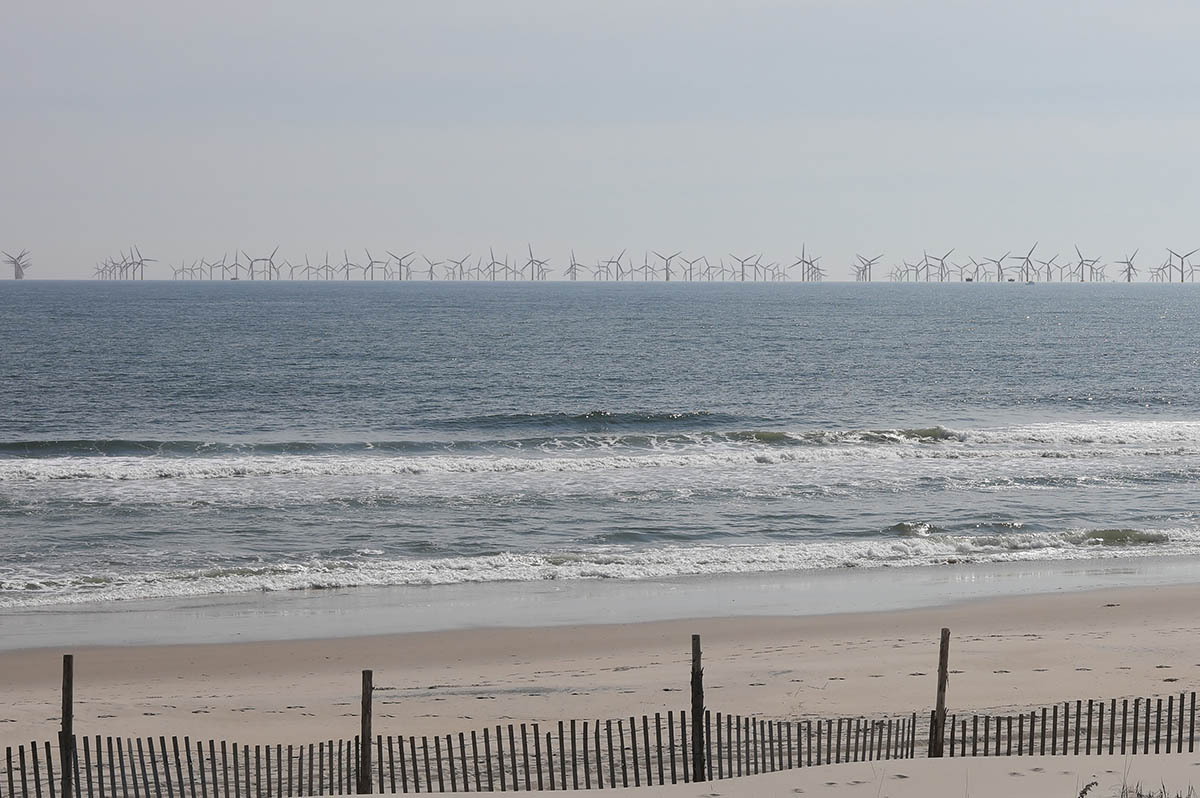
 

New Jersey’s Save LBI Coalition Sues U.S. Agencies and Atlantic Shores Offshore Wind, Challenging Federal Approvals Greenlighting Marine Ecosystem Devastation, Including Risks to Critically Endangered Whales

LONG BEACH ISLAND, N.J., Jan. 13, 2025 (SEND2PRESS NEWSWIRE) — Save Long Beach Island (LBI), an organization that has been actively litigating issues surrounding marine mammal, human health, economic, and other impacts connected to offshore wind industrialization off New Jersey since 2022, has filed suit against the U.S. Department of Commerce, National Marine Fisheries Service, Bureau of Ocean Energy Management, U.S. Department of Interior, and the Atlantic Shores Offshore Wind project for violations of a number of federal environmental statutes.

Visual simulation of Atlantic Shores South project - Source: Bureau of Ocean Energy Management
Photo caption: Visual simulation of Atlantic Shores South project from Holgate, New Jersey. Source: Bureau of Ocean Energy Management (BOEM).

“This lawsuit serves as the first of its kind, launching a wide-ranging challenge against Atlantic Shores’ federal approvals, based on violations of environmental statutes such as the National Environmental Policy Act, the Endangered Species Act, the Marine Mammal Protection Act, the Outer Continental Shelf Lands Act, the Coastal Zone Management Act, and the Clean Air Act,” said Thomas Stavola, Jr., Esq., the attorney representing Save LBI. “We believe we have organized a compelling case that will demonstrate that these federal agencies were derelict in their respective duties to take critical information into account, and moreover, made arbitrary assumptions that entirely failed to disclose and consider the injurious impacts of the Atlantic Shores South project.”

Bob Stern, Ph.D., the primary plaintiff and president of Save LBI, further explained, “For example, the agencies assume, incorrectly, that no North Atlantic right whales will suffer injury or death as a result of the Atlantic Shores South project. The evidence contradicts that assumption. In fact, our review and independent mathematical analyses shows a systemic underestimation of impact, and clearly indicate that the noise caused by pile driving, and, soon after, perpetual operational noise, will injure and kill high numbers of marine mammals — and, yes, injure and kill a number of North Atlantic right whales, a critically endangered animal that cannot afford to suffer any deaths given their numbers are now less than 340 total.”

The lawsuit ultimately seeks to have all federal approvals rescinded and the Atlantic Shores South project halted — stopping construction and preventing devastation to marine mammal life in the NJ/NY Bight regional waters. Eight other co-plaintiffs have joined Save LBI in this action, many of whom will be severely economically impacted due to the egregious harm to the marine ecosystem and the aesthetic, recreational blight imposed on the Jersey Shore via the circa 200 1,000-foot-plus high monstrosities slated to be constructed starting less than 9 miles east of Long Beach Island.

These inexcusable damages by the Atlantic Shores South project are not limited to marine mammal devastation, but also include significant impacts to tourism, shore economies, statewide energy bills, national defense, vessel navigation, and home values — all of which have been swept under the rug by much of the mainstream media, many elected officials, the Atlantic Shores company, and the federal agencies in their inexplicable haste to approve a project still in search of a clear purpose and need.

“We hope this lawsuit will serve as the vehicle to finally illuminate the damage being wrought here and to impose significant pressure on Atlantic Shores to withdraw, as their obfuscation of the project’s true effects are indefensible. The agencies simply cannot objectively argue that their approvals were made in accordance with the best science,” concluded Bob Stern.

This lawsuit was filed in federal court in the United States for the District of New Jersey on January 10, 2025.

About Save LBI

Save Long Beach Island (Save LBI) is an organization of citizens and businesses on and off the Island working together to protect the ocean and Long Beach Island and neighboring communities from the destructive impact of the Atlantic Shores project and potentially other offshore wind projects. As a not-for-profit, non-partisan entity, we do not endorse any political candidates but vigorously pursue policies and actions that protect the Island and New Jersey communities. The organization is led by Beach Haven resident Bob Stern, a Ph.D. engineer with experience in environmental law who previously managed the U.S. Department of Energy’s office overseeing environment protection related to energy programs and projects. Visit SaveLBI.org for more information and to make a donation.

Contact: https://www.savelbi.org/contact

For more information click here: https://www.savelbi.org

MULTIMEDIA:

Image link for media: https://www.Send2Press.com/300dpi/25-0113-s2p-savelbi-300dpi.jpg

Photo caption: Visual simulation of Atlantic Shores South project from Holgate, New Jersey. Source: Bureau of Ocean Energy Management (BOEM).

NEWS SOURCE: Save Long Beach Island (Save LBI)


This press release was issued on behalf of the news source (Save Long Beach Island (Save LBI)), who is solely responsible for its accuracy, by Send2Press Newswire. Image, if any, was provided by the news source and not this website or the wire service. Information is believed accurate, as provided by the news source, but is not guaranteed.

To view the original story, visit: https://www.send2press.com/wire/new-jerseys-save-lbi-coalition-sues-u-s-agencies-and-atlantic-shores-offshore-wind-challenging-federal-approvals-greenlighting-marine-ecosystem-devastation-including-risks-to-critically-endangere/

Copr. © 2025 Send2Press® Newswire, Calif., USA. -- REF: S2P STORY ID: S2P123305 NOREL-3B
 

New Jersey’s Save LBI Coalition Demands Full Disclosure of Structural and Safety Data for Atlantic Shores South Wind Turbines

BEACH HAVEN, N.J., Nov. 21, 2024 (SEND2PRESS NEWSWIRE) — Amid numerous recent instances of wind-turbine failures in the U.S. and around the world, the New Jersey citizen’s group Save LBI today called for an immediate and full public disclosure of all data related to the design, manufacture, maintenance, and failure rates for the components of the 200 wind turbines Atlantic Shores Offshore Wind plans to erect off the coast of southern Long Beach Island (LBI), Brigantine, and Atlantic City, New Jersey. It is also calling on the NJ Board of Public Utilities (NJ BPU) not to make any project-enabling new subsidy award unless and until that information is provided.

Vineyard Wind turbine-blade failure off Nantucket, MA in July (top); Vestas turbine collapse in August
Photo Caption: Vineyard Wind turbine-blade failure off Nantucket, MA in July (top); Vestas turbine collapse in August, one of three failures in six months at the Ameren wind farm in Schuyler County, MO.

The Vestas V236-15.0 MW turbine contracted for use by the Atlantic Shores South project is an unproven, first-of-its-kind design that stands 1,048 feet tall — three times the height of the Statue of Liberty — making it one of the tallest wind turbines in the world. It has three massive blades, each longer than a football field, which translates into 600 spinning behemoths in the Atlantic Shores South (OCS-A 0499) project area, the closest of which would be only 8.7 miles from shore, closer than anywhere else in the world.

Atlantic Shores should provide full, up-front disclosure on a number of issues, including:

  1. Technical details and Material Safety Data Sheets on all materials used in turbine manufacture.
  2. A discussion of the hazards associated with each material, including epoxies used for bonding.
  3. Failure rates and the potential consequences of turbine blade and other component failures impacting the marine environment, local food chain, and human life.
  4. Protocols for mitigating the environmental impact of turbine failures.
  5. Data on the structural integrity of the wind turbines (including the blades, towers, and other key components) as to their ability to withstand hurricanes, nor’easters, or other major storm events. (Project approvals have been granted even though a study by the National Offshore Wind Research and Development Consortium (NOWRDC) commissioned by the NJ Board of Public Utilities (BPU) has yet to be completed.)

In the wake of the blade failure at the Vineyard Wind project off the coast of Nantucket in July, Dr. Robert Stern, president of Save LBI, sent two letters to Atlantic Shores CEO Joris Veldhoven inviting Atlantic Shores to participate in a panel discussion at the LBI Foundation of the Arts & Sciences. Both were ignored, revealing a shocking level of arrogance and disrespect for a community that is justifiably concerned.

A Call for Transparency Amid the Rush to Build Ever-Larger Wind Turbines

Save LBI’s call for corporate and State Agency transparency follows a string of at least eight catastrophic offshore and onshore wind-turbine failures between April and November of 2024. The failures spanned three different turbine suppliers — Vestas, Siemens Gamesa, and GE Vernova — and involved not only collapsing blades but entire turbine structures toppling over [*notes 1-8]. Half of these failures involved Vestas turbines, causing great concern over the integrity of the colossal blades and supporting structures Atlantic Shores is planning to locate near New Jersey beaches [*note 9].

According to a 2023 report in Maintworld, a magazine for maintenance and asset management professionals, “turbine failures are on the uptick across the world…The instances are part of a rash of full collapses. A recent report says production issues may be to blame for the mysterious increase in failures [*note 10].”

In a May 2023 report entitled “Vertical Limit: When is bigger not better in offshore wind’s race to scale?” GCube Insurance, an underwriter for renewable energy projects, reviewed 10 years of claims data and found “offshore wind’s risk landscape has significantly shifted, as manufacturers push to develop bigger machines…Over the past five years, the race to scale turbine technologies has seen the leap from 8 megawatt (MW) to 18 MW turbines occurring in a fraction of the time it took to go from 3 MW to 8 MW. While this is a fantastic technological achievement, such rapid commercialization of ‘prototypical’ technologies is now leading to a concerning number of losses, and subsequently piling financial pressure on manufacturers, the supply chain, and the insurance market, according to GCube.” [*note 11]

Save LBI’s demand for accountability also comes amid revelations of a quality-control-data falsification scheme at a blade manufacturing facility in Canada [*note 12], and concern that such misrepresentations could be an industry-wide problem. “Our sources indicate that [falsifying data] is a widespread practice in the industry,” according to a Radio Gaspésie report [*note 13].

NJ: The De Facto Test-Bed for Super-Sized Wind Turbines

Atlantic Shores will be among the first to deploy the “super-sized” Vestas V236-15.0 MW wind turbine, which has never been tested in the harsh marine environment it will inhabit. Instead, testing was done on a land-based prototype turbine at the Østerild National test center in Denmark. New Jersey will, in effect, become a real-world Guinea pig for these newly designed gargantuan turbines.

In a series of videos on vestas.com, company executives boast how Vestas is “…leading the way into this new super-sized segment of wind turbines” and “…entering into some unprecedented territory on many of the manufacturing processes that we employ for building the blade [emphasis added]. We need to scale up renewables fast and the V236 15.0 megawatt is there to do just that. [*note 14].”

The structural integrity of the new “super-sized” blades is of particular concern to Save LBI and local communities because they are primarily made of a fiberglass composite similar to the material used in the GE Vernova Haliade-X blade [*note 15], which spontaneously collapsed while undergoing testing at the Vineyard Wind project. The blade failure sent countless shards of fiberglass and pieces of foam into the ocean, causing beach closures during the height of tourist season and putting marine life and the local food chain at risk.

“The Vineyard Wind disaster and the many others like it are wake-up calls that raise serious concerns about the structural integrity of wind turbines and the long-term impact of such failures on the environment — the effects of which are still being felt in Nantucket four months later [*note 16],” Dr. Stern said. “Even some proponents of offshore wind are now questioning whether the obvious risks are worth the purported benefits. Is this what those of us who live in the shadow of Atlantic Shores South have to look forward to?”

“It’s past time for NJ BPU staff and Atlantic Shores to directly engage and disclose the full impact of this ominous offshore wind project to the local communities that will be directly affected by it before any further work or decision-making proceeds,” he concluded.

About Save LBI

Save Long Beach Island (Save LBI) is an organization of citizens and businesses on and off the Island working together to protect the ocean and Long Beach Island and neighboring communities from the destructive impact of the Atlantic Shores project and potentially other offshore wind projects. As a not-for-profit, non-partisan entity, we do not endorse any political candidates but vigorously pursue policies and actions that protect the Island and New Jersey communities. The organization is led by Beach Haven resident Bob Stern, a Ph.D. engineer with experience in environmental law who previously managed the U.S. Department of Energy’s office overseeing environment protection related to energy programs and projects. Visit SaveLBI.org for more information and to make a donation.

Contact: https://www.savelbi.org/contact.

For more information click here: https://www.savelbi.org/.

References

Note: If a link doesn’t work, copy and paste the URL into a browser.

  1. Halkirk 2 wind facility shut down after [Vestas] turbine breaks, Nov. 9, 2024, https://calgary.ctvnews.ca/halkirk-2-wind-facility-shut-down-after-turbine-breaks-1.7104801
  2. Blade broken off Siemens Gamesa turbine at Swedish wind farm, Nov. 7, 2024, https://energywatch.com/EnergyNews/Renewables/article17617839.ece
  3. [Vestas] Wind turbine collapses in Schuler County [Missouri], third incident in six months, Oct. 31, 2024, https://khqa.com/news/local/wind-turbine-collapses-in-schuyler-county-third-incident-in-six-months

    https://www.rechargenews.com/wind/third-vestas-turbine-collapse-forces-us-wind-farm-offline/2-1-1733379

  4. [Vestas] Wind Turbine collapses in Schuyler County, Missouri, Aug. 27, 2024, https://www.youtube.com/watch?v=tQHl5hTV5a0
  5. Second GE Vern ova turbine blade reportedly fails at UK’s Dogger Bank wind farm, Aug. 23, 2024, https://www.offshore-mag.com/renewable-energy/article/55135538/second-ge-vernova-turbine-blade-reportedly-fails-at-uks-dogger-bank-wind-farm
  6. Vineyard Wind incident was not first time a GE Vernova wind turbine came apart, Reuters, July 18, 2024 https://www.reuters.com/business/energy/vineyard-wind-incident-was-not-first-time-ge-vernova-wind-turbine-came-apart-2024-07-18/
  7. Dogger Bank Makes Statement on Site Incident [GE Vernova blade], May 10, 2024, https://nawindpower.com/dogger-bank-makes-statement-on-site-incident
  8. All northeastern [Vestas] wind turbines taken offline after 1 collapses in Schuyler County [on April 26], May 3, 2024, https://www.youtube.com/watch?v=6sUCoZJ1Asc
  9. Energy analyst Philip Totaro on Vestas failures at the Ameren wind farm in Missouri, Nov. 2024, LinkedIn post: “The High Prairie hashtag#windenergy project in Schuyler County, Missouri suffers the third wind turbine collapse in six months. The project, owned by Ameren, has 163 units of Vestas V120 2.2-MW on 92 meter towers and 12 units of Vestas V112 3.45-MW on 94 meter towers. The causes of the previous collapses have not been publicly released.”

    https://www.linkedin.com/posts/philiptotaro_another-turbine-collapses-in-schuyler-county-activity-7257949289107120128-br3K?utm_source=share&utm_medium=member_desktop

  10. Why do wind turbines break down more often? Jan. 31, 2023, https://www.maintworld.com/Asset-Management/Why-do-wind-turbines-break-down-more-often
  11. Ever-Growing Offshore Wind Turbines Bring Unsustainable Market Risks – GCube, May 4, 2023, https://www.offshorewind.biz/2023/05/04/ever-growing-offshore-wind-turbines-bring-unsustainable-market-risks-gcube/

    https://gcube-insurance.com/Insights/Reports/Vertical-Limit

  12. Canada station reports “falsification scheme” at turbine plant, Nov. 12, https://www.mvtimes.com/2024/11/12/canada-station-reports-falsification-scheme-turbine-plant/
  13. Possible falsification of data at LM Wind Power, Oct. 24, 2024, https://www.radiogaspesie.ca/nouvelles/actualite/falsification-possible-de-donnees-chez-lm-wind-power/
  14. Official documentation for the Vestas V236-15.0 MW wind turbine to be used in Atlantic Shores South project, com/en/energy-solutions/offshore-wind-turbines/V236-15MW
  15. Official documentation for the GE Vernova Haliade-X offshore wind turbine used in the Massachusetts Vineyard Wind project, com/wind-power/offshore-wind/haliade-x-offshore-turbine
  16. GE Vernova and Vineyard Wind Provide Update on Incident and Response Action Plan, Oct. 23, 2024, com/press-releases/2024/10/23/ge-vernova-and-vineyard-wind-provide-update-on-incident-and-response-action-plan

MULTIMEDIA:

Photo link for media: https://www.Send2Press.com/300dpi/24-1121-s2p-savelbipic-300dpi.jpg

Photo Caption: Vineyard Wind turbine-blade failure off Nantucket, MA in July (top); Vestas turbine collapse in August, one of three failures in six months at the Ameren wind farm in Schuyler County, MO.

NEWS SOURCE: Save Long Beach Island (Save LBI)


This press release was issued on behalf of the news source (Save Long Beach Island (Save LBI)), who is solely responsible for its accuracy, by Send2Press Newswire. Image, if any, was provided by the news source and not this website or the wire service. Information is believed accurate, as provided by the news source, but is not guaranteed.

To view the original story, visit: https://www.send2press.com/wire/new-jerseys-save-lbi-coalition-demands-full-disclosure-of-structural-and-safety-data-for-atlantic-shores-south-wind-turbines/

Copr. © 2024 Send2Press® Newswire, Calif., USA. -- REF: S2P STORY ID: S2P122427 NOREL-3B
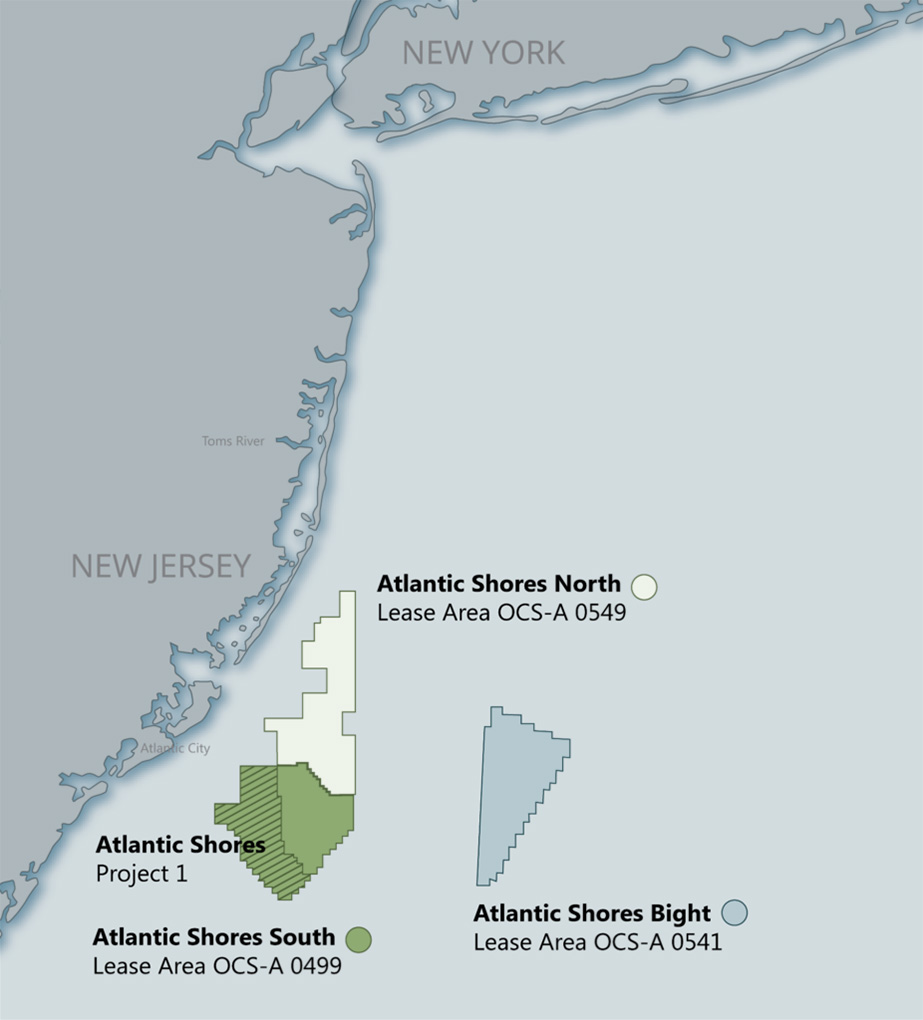
 

NJ Coalition Demands Full Accounting of All Costs Associated with Controversial Atlantic Shores South Offshore Wind Project

Save LBI Urges NJ Board of Public Utilities to Include Costs Omitted in Prior Review of the Multibillion Project

BEACH HAVEN, N.J., Nov. 12, 2024 (SEND2PRESS NEWSWIRE) — Save Long Beach Island (Save LBI), a New Jersey citizens group working to protect the ocean and local shore communities from the destructive impact of offshore wind projects, has called on the New Jersey Board of Public Utilities (BPU) to conduct a comprehensive cost-benefit analysis of the federally-approved Atlantic Shores Offshore Wind South project that includes costs omitted in previous economic analyses of the controversial plan to place two-hundred wind turbines off the coast of southern Long Beach Island, Brigantine, and Atlantic City.

Visual simulation of Atlantic Shores South project as it would appear from Holgate, NJ. Source: Bureau of Ocean Energy Management (BOEM)
Photo caption: Visual simulation of Atlantic Shores South project from Holgate, New Jersey. Source: Bureau of Ocean Energy Management (BOEM).

If the additional anticipated subsidies are approved, the project would cost New Jerseyans an estimated $110 billion over its lifespan, almost twice the amount of the entire State budget for 2025 of $55.9 billion, according to Save LBI. This staggering amount includes $73 billion in generic costs that occur for all such projects and an additional $37 billion in costs associated with siting 1,048-foot-tall wind turbines radically close to the coast. (See generic and site-specific cost breakdowns below.)

The State’s Offshore Wind and Economic Development Act requires a cost-benefit analysis showing a net benefit to the State before electric rate subsidies can be awarded to an offshore wind project. In a letter dated October 30, Save LBI asked the NJ BPU to include costs that were not factored into the previous financial calculus for the Atlantic Shores South project, including the sizeable cost associated with siting the turbines closer to shore than anywhere else in the world.

“The BPU is looking at spending an enormous amount of public money on a single project,” said Bob Stern, president and co-founder of Save LBI. “It’s no wonder potential recipients of that largess show up in droves at wind-energy-sponsored events such as the Offshore Windpower Conference & Exhibition held recently in Atlantic City.”

Save LBI has provided a breakdown of the $110 billion project cost to the BPU and awaits the Board’s award decision and cost-benefit analysis to see: (1) the full costs of the Atlantic Shores South project, (2) what possible benefit would outweigh this huge cost in order to satisfy the State’s “net benefit” test, and (3) how the extra $37 billion could be justified compared to other projects. The NJ BPU is expected to make a final determination in December.

Save LBI has also called on NJ State legislators to review and hold hearings on these costs to determine whether or not the Atlantic Shores South project is a wise use of the State’s limited resources.

GENERIC COSTS OF ATLANTIC SHORES SOUTH

1. Substantially higher electricity rates across the State’s residential, commercial, and industrial sectors. The BPU is considering a more highly subsidized price for the Atlantic Shores project that would increase average bills by around 12% (11% residential, 13% commercial, and 15% industrial). Based on 2024 numbers, the cost of this increase over the lifetime of the project would be $20 billion [*note 1]. It’s worth noting that the NJ BPU has underestimated prior electric bill increases by about 40% [*note 2].

2. State investment in the Paulsboro, Salem County, and Sea Girt facilities. In addition to direct subsidies of individual offshore wind projects, the State is investing substantial NJ taxpayer money to provide infrastructure support for the Atlantic Shores South project and other offshore wind projects. To date it has committed at least $250 million for the Paulsboro marine terminal [*note 3], $637.6 million (with another $462 million planned) for the Salem county windport,[*Note 4] and another $1.2 billion for the Sea Girt/Larrabee transmission system/upgrade (with an additional $7.1 billion expected to follow) [*note 2]. Combined, we’re looking at another $9.7 billion. And this does not take into account a new, even more costly offshore transmission system, now on the drawing boards, that would divert power from wind projects off the coast of NJ to New York. All of these additional State costs should be proportionally allocated to each project that will use them when evaluating costs verses benefits, with an assumed $3 billion allocated to this project.

3. Loss in business revenue and jobs due to electric rate increases. A 2011 study [*note 5] found that a 2 percent increase in Statewide electric rates results in an annual loss of 2,219 jobs, with an average decrease in wages of $111 per year, which adds up to a Statewide loss of $330 million in annual disposable income. A 12 percent rate increase from the Atlantic Shores project would result in a present (2024) value cost increase of $40 billion [*note 1]. Costs such as these have been omitted from previous BPU cost-benefit analyses, but are major and should be included.

4. State cost of removal and onshore processing of wind turbines at the end of their useful life. These costs are likely to fall to the State because there are no federal or State requirements for the company to remove the turbines. What’s more, Atlantic Shores or government agencies have never disclosed a feasibility study or cost analysis for the removal and onshore processing of the turbines — a massive undertaking that could approach the cost of installation, on the order of $10 billion. The BPU cost benefit analysis should clearly state whether turbine removal and processing is included in the project decommissioning plan, what cost was allocated toward that, and what provision was made to provide for financial assurance for funding that cost. It should be noted that any failure to address this issue, resulting in the turbines left in place after their useful life, would incur additional long-term costs such as those discussed below in items 6, 7 and 8.

5. Energy back-up costs and the “wake effect.” The introduction of intermittent wind-powered energy to the regional electric supply system requires more back-up sources, potentially within New Jersey. In addition, the BPU has not considered the “wake effect”: how wind is diminished in a row of turbines that is downwind from another row, which will significantly reduce the power output of the Atlantic Shores project due to the close spacing between turbines. A recent study [*note 9] of a wind complex close to the Atlantic Shore South area indicates that the internal wake effect within the complex itself is significant in terms of reductions in wind speed. The nature and cost of the necessary energy back-up should be included to attain an accurate cost-benefit analysis.

ADDITIONAL COSTS ASSOCIATED WITH SITING WIND TURBINES CLOSE TO SHORE

6. Loss in tourism. A 2024 study [*note 6] estimated the Atlantic Shores project would cause a $668 million loss in annual tourism revenue and the loss of 6,700 tourism-related jobs per year in Ocean County, NJ, attributable to the project off Long Beach Island. The present (2024) value of that lost tourism revenue would add up to $12 billion over the first 20 years of turbine operations. Another 2024 study [*note 7] estimates an additional annual $1.6 billion loss in tourism revenue in neighboring Atlantic County, with related job losses of 10,700 per year and a total cost to Atlantic County of $21 billion over the lifetime of the project. The total expected loss in tourism revenue over the life of the Atlantic Shores project for both areas is $33 billion. Such costs have not been addressed in prior BPU cost-benefit analyses, but are major and should be included.

7. Decline in property values. Government agencies and wind developers like to cite a Block Island (Rhode Island) study to conclude that offshore wind development will have no impact on property values. But this is highly misleading because Block Island only has only five small wind turbines located off rocky coasts and cliffs, much farther and less visible from popular beaches. Five turbines is a long way from 200, each three times the height of the Statue of Liberty and less than 9 miles from shore at their closest point.

A study commissioned by the NJ BPU [*note 8] that examined how the visibility of offshore wind turbines would impact property values found that oceanfront and ocean-view properties would lose significant value. It assumed that an oceanfront or ocean-view property would drop to the value of the row behind it with turbines visible. Applying that principle to the 1,100 oceanfront properties on LBI predicts a reduction in property value of 38 percent for each home, for a total loss in property value of $1.6 billion; homes one house away from the beach would each experience a 25 percent reduction in value for an additional loss of $0.6 billion. A similar analysis conducted for Brigantine Beach [*note 7] shows losses of up to $0.8 billion for the first two rows of houses nearest the ocean.

This results in a total loss of $3 billion just for the first two rows closest to the ocean in these two towns, and would likely have a cascading effect on other property values. Anticipated losses in property value and tax revenue for all affected structures were missing from prior BPU cost benefit analyses and should be included in the cost-benefit analysis of the Atlantic Shores South project.

8. State costs for beach cleanups of debris from wind-turbine component failures. These costs are uncertain because offshore wind companies and government agencies have not released an analysis of the frequency and consequences of turbine component failures. But, as we know from the Vineyard Wind turbine failure off the coast of Nantucket in July, the cost of removing fiberglass and other debris from beaches is substantial, as is the comparable cost of cleaning up beaches in the aftermath of vessel wrecks, which have run into tens to hundreds of millions of dollars. Depending on failure frequency, the cost of such cleanups over the project’s lifetime could approach $1 billion, or even more if failures occur during tourist season. Costs covering the eventuality of turbine failures have not been factored into prior BPU cost benefit analyses but should be accounted for in the cost-benefit analysis of the pending Atlantic Shores South project.

About Save LBI:

Save Long Beach Island (Save LBI) is an organization of citizens and businesses on and off Long Beach Island (LBI), New Jersey working together to protect the ocean and the Island and neighboring communities from the destructive impact of Atlantic Shores offshore wind projects, and potentially others in the future. As a not-for-profit, non-partisan entity, we do not endorse any political candidates but vigorously pursue policies and actions that protect the Island and surrounding communities. The coalition is led by Beach Haven resident Dr. Bob Stern, a Ph.D. engineer with experience in environmental law who previously managed the U.S. Department of Energy’s office overseeing environment protection related to energy programs and projects. Visit SaveLBI.org for more information and to make a donation.

Contact: https://www.savelbi.org/contact.

For more information click here: https://www.savelbi.org

REFERENCES:

  1. Economic Analysis of the Atlantic Shores South Offshore Wind Projects, Edward, P. O’Donnell, White Strand Consulting LLC, August 2024
  2. Economic Analysis of the Attentive and Leading Light Offshore Wind Projects, Edward P. O’Donnell, White Strand Consulting LLC, August 2024, Table 6-1
  3. NJ Governor’s Office press release, 12/21/2020, gov/governor/news/news/562020/approved/20201222a.shtml
  4. NJ Economic Development Authority NJ Wind Port Prospectus, njwindport.njeda.gov
  5. The Cost and Economic Impact of New Jersey’s Offshore Wind Initiative, Beacon Hill Institute at Suffolk University, June 2011
  6. Potential Economic Losses of Reduced Tourism Attributable to Proposed Wind Turbines in Long Beach Island, NJ, Tourism Economics, March 2024
  7. Report to Atlantic County Commissioners on Offshore Wind Developments, the Industrialization of Our Ocean and Impact to Our Local Economy, April, 2024, Defend Brigantine Beach
  8. An Assessment of the Potential Costs and Benefits of Offshore Wind Turbines, Global Insight, 2008
  9. Estimating Long-Range External Wake Losses in Energy Yield and Operational Performance Assessments Using the WRF Wind Farm Parameterization, Arc Vera Renewables, 2022

MULTIMEDIA:

PHOTO link for media: https://www.Send2Press.com/300dpi/24-1008-s2p-savelbi-300dpi.jpg

Photo caption: Visual simulation of Atlantic Shores South project from Holgate, New Jersey. Source: Bureau of Ocean Energy Management (BOEM).

NEWS SOURCE: Save Long Beach Island (Save LBI)


This press release was issued on behalf of the news source (Save Long Beach Island (Save LBI)), who is solely responsible for its accuracy, by Send2Press Newswire. Image, if any, was provided by the news source and not this website or the wire service. Information is believed accurate, as provided by the news source, but is not guaranteed.

To view the original story, visit: https://www.send2press.com/wire/nj-coalition-demands-full-accounting-of-all-costs-associated-with-controversial-atlantic-shores-south-offshore-wind-project/

Copr. © 2024 Send2Press® Newswire, Calif., USA. -- REF: S2P STORY ID: S2P122222 NOREL-3B


NJ Coalition Slams Feds for Ignoring Key Environmental Impacts of Offshore Wind Development

Save LBI Calls Out Bureau of Ocean Energy Management for Flouting the National Environmental Policy Act and Misleading the Public

BEACH HAVEN, N.J., Oct. 25, 2024 (SEND2PRESS NEWSWIRE) — The New Jersey citizens group Save Long Beach Island (Save LBI) today rebuked the federal Bureau of Ocean Energy Management (BOEM) for issuing a final Environmental Impact Statement (EIS) that blatantly ignores critical environmental impacts for offshore wind development in six lease areas off the coast of New Jersey and New York in a region known as the New York Bight. The area lies to the north of the controversial Atlantic Shores South project (OCS-A 0499) off the southern coast of New Jersey, which received federal approval in July.

Map showing the six offshore-wind lease areas in the New York Bight region off the coast of New Jersey and New York. Source: BOEM.
Image caption: Map showing the six offshore-wind lease areas in the New York Bight region off the coast of New Jersey and New York. Source: BOEM.

BOEM’s Final Programmatic Environmental Impact Statement (Final PEIS) flouts the intent of the National Environmental Policy Act (NEPA) and masquerades as a “comprehensive” environmental review as it fails to address the most significant environmental decisions: the location of a wind project and the number and size of the wind turbines to be placed in the project area — decisions BOEM quietly covets for itself and the developer to make, according to Save LBI, the grassroots organization dedicated to protecting the New Jersey shore environment.

The 600-plus-page EIS, which is intended to justify BOEM’s selection of lease areas in the New York Bight region, remarkably only addresses technical mitigating measures, such as spotting whales at long distances, which unfortunately is largely ineffective and not environmentally significant.

“BOEM will now proceed to prepare EIS’s for projects within the New York Bight area without offering any real, environmentally different alternatives — only a choice to approve or disapprove the proposed developer’s project,” said Bob Stern, president and co-founder of Save LBI. “The real travesty here is that the outcome is already largely pre-determined since BOEM provides no criteria in those documents that would lead to disapproval of a project.”

In so doing, BOEM sidesteps the intent of the National Environmental Policy Act (NEPA), enacted by Congress in 1970 to compel government agencies to seriously consider environmental impact when they make their most important and environmentally impactful decisions and to look at alternative means of accomplishing their goals through the process of preparing an EIS and allowing for public input.

Even more egregious, at no point in the flawed BOEM NEPA review process is the public allowed to inject its views and concerns regarding the most crucial environmental decisions of location and project size. “The BOEM process not only flouts NEPA’s intent but misleads and insults the public by following the ineffective and inefficient past process of pursuing only a single developer proposal, regardless of the potential environmental impact, and rendering the public’s input meaningless. It is situations like this that led to the passage of NEPA in the first place.”

Save LBI will be challenging the BOEM NEPA review process in court. The legality of that process will be determined by a judge, but from the standpoint of making sound decisions informed by the public, this is not a process to embrace.

About Save LBI:

Save Long Beach Island (Save LBI) is an organization of citizens and businesses on and off Long Beach Island (LBI), New Jersey working together to protect the ocean and the Island and neighboring communities from the destructive impacts of offshore wind projects. As a not-for-profit, non-partisan entity, we do not endorse any political candidates but vigorously pursue policies and actions that protect the Island and surrounding communities. The coalition is led by Beach Haven resident Dr. Bob Stern, a Ph.D. engineer with experience in environmental law who previously managed the U.S. Department of Energy’s office overseeing environment protection related to energy programs and projects.

Visit SaveLBI.org for more information and to make a donation. Click here: https://www.savelbi.org/

IMAGE LINK:

New York Bight

Click here: https://www.boem.gov/sites/default/files/images/lease_areas_image.png

Photo Caption: Map showing the six offshore-wind lease areas in the New York Bight region off the coast of New Jersey and New York. Source: BOEM.

NEWS SOURCE: Save Long Beach Island (Save LBI)


This press release was issued on behalf of the news source (Save Long Beach Island (Save LBI)), who is solely responsible for its accuracy, by Send2Press Newswire. Image, if any, was provided by the news source and not this website or the wire service. Information is believed accurate, as provided by the news source, but is not guaranteed.

To view the original story, visit: https://www.send2press.com/wire/nj-coalition-slams-feds-for-ignoring-key-environmental-impacts-of-offshore-wind-development/

Copr. © 2024 Send2Press® Newswire, Calif., USA. -- REF: S2P STORY ID: S2P121738 NOREL-3B


NJ Coalition Fights Destructive Impact of Atlantic Shores Offshore Wind South Project

Save LBI Notifies Federal Agencies of Intent to Sue Over Breach of Endangered Species Act and Outer Continental Shelf Lands Act

BEACH HAVEN, N.J., Oct. 8, 2024 (SEND2PRESS NEWSWIRE) — Save Long Beach Island (Save LBI), a New Jersey citizens group working to protect the ocean and local shore communities from the destructive impact of the Atlantic Shores Offshore Wind South project, has notified federal agencies of its intent to sue Atlantic Shores under the Endangered Species Act and Outer Continental Shelf Act (OCSLA).

Visual simulation of Atlantic Shores South project as it would appear from Holgate, NJ. Source: Bureau of Ocean Energy Management (BOEM)
Image caption: Visual simulation of Atlantic Shores South project as it would appear from Holgate, New Jersey. Source: Bureau of Ocean Energy Management (BOEM).

The notices give the Bureau of Ocean Energy Management (BOEM) and National Oceanic and Atmospheric Administration (NOAA) 60 days to resolve issues raised in the filings before the coalition pursues litigation. BOEM oversees offshore wind development in the United States and NOAA manages the use of our marine resources.

Save LBI contends that constructing and operating hundreds of wind turbines directly in a prime migration path of the critically endangered North Atlantic right whale could push these mammals into extinction. The population of the right whale is down to approximately 338, with fewer than 70 reproductively active females, according to NOAA estimates.

“Underwater noise from the massive, diesel-powered hammers that will be used to ‘pile drive’ 50-foot-wide turbine foundations into the seabed as well as from vessel surveys and the operation of those turbines will obstruct the essential migration of the right whale as it attempts to pass through those waters, jeopardizing the whale’s existence while violating the Endangered Species Act,” said Bob Stern, president and co-founder of Save LBI.

Save LBI further maintains that BOEM and NOAA have, without sound justification, dismissed the significant problem of operational noise from the larger and noisier turbines Atlantic Shores plans to build off the coast of New Jersey. “The agencies routinely cite lower noise levels from smaller turbines to avoid addressing the problem of higher noise levels from larger turbines,” Stern said.

With respect to the Endangered Species Act, the agencies have also failed to consider, let alone study, the impact all wind-turbine projects along the East Coast would have on the right whale’s migration.

“And this is just one of many problems that will be created by the Atlantic Shores South wind project, which, shockingly, has already received federal approval,” Stern added.

Safeguarding the Natural Environment, Fishing, and National Security Under OCSLA

Save LBI asserts that BOEM and NOAA did not adequately account for how the Atlantic Shores offshore wind farm will interfere with other uses of the ocean — particularly vessel navigation, fishing, including the New Jersey surf clam industry, and national defense — as required by OCSLA, which gives the federal government the authority to lease areas of the ocean.

Save LBI further contends that the federal agencies acted in an arbitrary manner when they approved the placement of hundreds of wind turbines weighing hundreds of thousands of tons in the ocean with no plan or capability, technically or monetarily, to remove them at the end of their useful life or upon their failure during normal operation or in the aftermath of a hurricane or extreme storm event.

BOEM and NOAA have also failed to account for structural failures, such as the Vineyard Wind turbine blade that spontaneously collapsed off the coast of Nantucket Island in July, the damage from such failures to the ocean and beaches, how that damage will be remediated, and who will pay for it.

Atlantic Shores Offshore Wind Project Overview

The Atlantic Shores South project and planned Atlantic Shores North project, would industrialize the New Jersey coastline between Atlantic City and Barnegat Light with the installation of the 357 wind turbines, each three times the height of the Statue of Liberty. The greater New Jersey/New York offshore wind plan embraced by the federal government could ultimately include more than 2,000 wind turbines.

This project area, selected many years ago with no public consideration of wind turbine impact, would place the largest turbines available less than 9 miles off a beautiful 18-mile barrier island beach, closer than any other wind project in the world and in a primary migration path of a critically endangered whale. The project would:

  • Jeopardize that whale’s existence due to the project’s high levels of underwater noise.
  • Destroy the shore experience with highly visible turbines and disturbing blade rotation, airborne noise, reduced breeze, and higher air temperature and humidity.
  • Degrade the nearby Brigantine National Wilderness Area from construction air pollutants.
  • Have a severe economic impact on tourism, jobs, rentals, property value, and tax revenues.
  • Dramatically increase electric bills to every user in New Jersey, placing an additional financial burden on households and businesses.
  • Require new infrastructure and substantial long-term funding for turbine removal.
  • Remove key fishing grounds.
  • Impair defense air radars in Gibbsboro, NJ.
  • Have only a “negligible” effect on climate change, according to the official impact statement. Because climate change is caused by global heat transfer that is already underway, this project would only delay future sea level rise for a matter of days, not stop or even reduce it.

“It should be obvious to any objective decision-maker that siting a huge offshore wind project that brings this extraordinary degree of short and long-term environmental and social damage, with no clear project purpose to justify that, is a big mistake,” Stern concluded. “Decision-makers should acknowledge the significant new information that has come forward since this area was selected, recognize the strength of the legal challenges ahead, and change course to save everyone on both sides of this issue a lot of time, work, and money.”

Save LBI Legal Challenges at a Glance

Save LBI is pursuing a series of legal actions against the Atlantic Shores South project. One case regarding wind companies vessel surveys and recent whale deaths is already in court, and the organization recently filed suit against Atlantic Shores Offshore Wind, declaring the project will violate local noise ordinances and nuisance criteria. Save LBI will be fighting in court to:

  • Protect marine mammals, including critically endangered whales, under the Endangered Species Act and the Marine Mammal Protection Act.
  • Dispute the project’s Environmental Impact Statement (EIS) and the entire governmental review process under the National Environmental Policy Act; that review process has not allowed for the consideration of meaningful alternatives, which should be the “heart of any EIS.
  • Prevent excessive electric bill increases under the New Jersey’s Offshore Wind Energy Development Act by challenging the flawed cost-benefit analysis on which the NJ Board of Public Utilities pending award is based.
  • Safeguard vessel navigation, fishing, and national defense uses of the ocean under the Outer Continental Shelf Lands Act.
  • Protect the NJ Coastal Zone under the Coastal Zone Management Act.
  • Protect the Brigantine National Wilderness Area from air quality degradation.

About Save LBI:

Save Long Beach Island (Save LBI) is an organization of citizens and businesses on and off Long Beach Island (LBI), New Jersey working together to protect the ocean and the Island and neighboring communities from the destructive impact of Atlantic Shores offshore wind projects, and potentially others in the future. As a not-for-profit, non-partisan entity, we do not endorse any political candidates but vigorously pursue policies and actions that protect the Island and surrounding communities. The coalition is led by Beach Haven resident Dr. Bob Stern, a Ph.D. engineer with experience in environmental law who previously managed the U.S. Department of Energy’s office overseeing environment protection related to energy programs and projects. Visit SaveLBI.org for more information and to make a donation.

For more information click here: https://www.savelbi.org/.

LINKS:

Save LBI Coalition Calls for Moratorium on BPU Awards for Offshore

Click here (PDF): https://www.savelbi.org/_files/ugd/a85a2b_2f621b9f4a9746ab9255d2cd1a33139e.pdf

Save LBI Files Lawsuit Declaring Airborne Noise from the Atlantic Shores South Offshore Wind Project Violates New Jersey Land Use Law, Local Ordinances, and Creates a Private Nuisance

Click here (PDF): https://www.savelbi.org/_files/ugd/a85a2b_08ce714c2a6044a58b97a02abe309e18.pdf

MULTIMEDIA:

Image link for media: https://www.Send2Press.com/300dpi/24-1008-s2p-savelbi-300dpi.jpg

Image caption: Visual simulation of Atlantic Shores South project as it would appear from Holgate, New Jersey. Source: Bureau of Ocean Energy Management (BOEM)

NEWS SOURCE: Save Long Beach Island (Save LBI)


This press release was issued on behalf of the news source (Save Long Beach Island (Save LBI)), who is solely responsible for its accuracy, by Send2Press Newswire. Image, if any, was provided by the news source and not this website or the wire service. Information is believed accurate, as provided by the news source, but is not guaranteed.

To view the original story, visit: https://www.send2press.com/wire/nj-coalition-fights-destructive-impact-of-atlantic-shores-offshore-wind-south-project/

Copr. © 2024 Send2Press® Newswire, Calif., USA. -- REF: S2P STORY ID: S2P121340 NOREL-3B